The Coffee-to-Water Ratio: Set Your Flavor by the Numbers, From One Cup to a Crowd
What 1:15–1:18 means, and the basics of dialing strength by measuring
Same beans, different coffee-to-water ratio — and the taste changes entirely. The fastest route to a repeatable, great cup is to stop eyeballing and “measure by ratio.” What the golden ratio of 1:15–1:18 means, a per-cup quick table, adjusting strength, and recommended ratios by brew method — here’s how to design flavor by the numbers.
Contents · 8
“I bought the same beans, but it doesn’t taste like the café.” More often than not, the cause is the amounts, not the technique. The fastest way to stabilize coffee is to stop eyeballing and measure the ratio of coffee (grounds) to water by weight. That’s why pros always use a scale. Fix the ratio and the taste becomes remarkably repeatable.
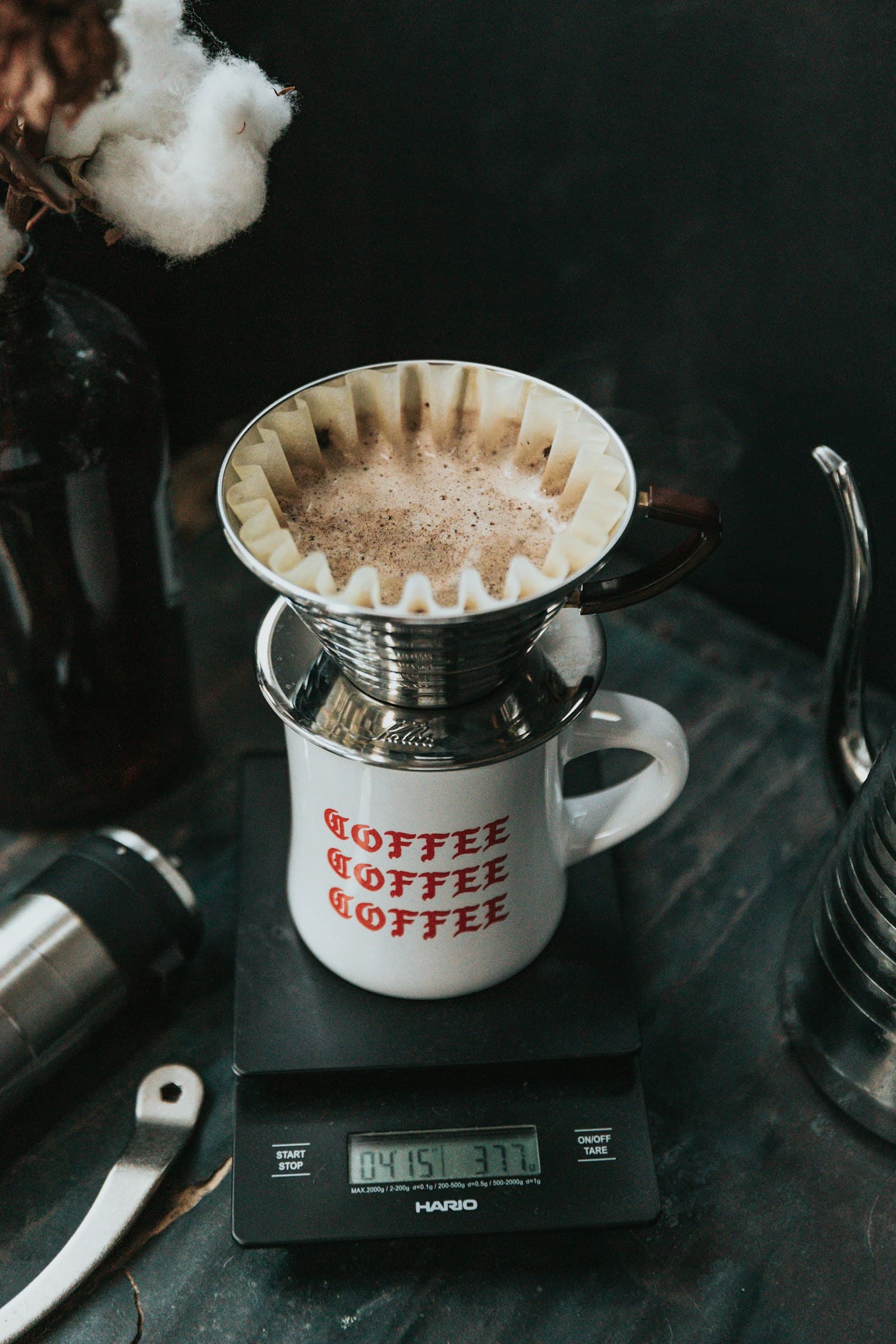
Measure the ratio by weight (g), not volume (cc / spoons). Water is about 1g ≒ 1ml, so leaving water in ml is fine. A 0.1g coffee scale makes things far more consistent.
What the “golden ratio” is
The golden ratio is the ratio by weight of coffee grounds to water. For typical drip it’s around 1:15–1:18; the SCA (Specialty Coffee Association) standard is about 1:18. The smaller the number, the stronger; the larger, the weaker. When unsure, start in the middle at 1:16.
The golden ratio to anchor on, 1:16 (15g grounds : 240g water)
Beans 15g / Water 240g
Per-cup quick table (calculated at 1:16)
Using 1:16 as the base, the grounds and water you need fall out like this. As servings grow, keep the ratio fixed and scale only the amounts.
- 1 cup (about 220ml finished): 15g grounds : 240g water
- 2 cups: 25g grounds : 400g water
- 3 cups: 35g grounds : 560g water
- 4 cups: 45g grounds : 720g water
- Note: the drinkable amount ends up a bit less than the water added, since grounds retain water (about 2g per 1g of grounds)
“How many ml is one cup?” depends on your preference, but for drip, 200–250g of water per cup is common. For a big mug, go higher; for a small, strong demitasse, go lower — adjust the total while keeping the ratio.
Adjusting strength — change the ratio vs. change the grind
When you want it “stronger / weaker,” there are two places to touch. Don’t confuse them.
- Ratio (amount of grounds and water) = changes “strength.” More grounds = stronger; more water = weaker
- Grind / temperature / time = changes the “degree of extraction” (the balance). Finer / hotter / longer = more is extracted
- It’s tidier to set strength with the ratio first, then fine-tune any harshness or thinness with the grind
Good and strong, 1:15 (15g grounds : 225g water)
Beans 15g / Water 225g
Light and clean, 1:18 (15g grounds : 270g water)
Beans 15g / Water 270g
Recommended ratios by brew method
The ideal ratio differs a little by equipment. Keep these as baselines and you won’t go far wrong even with a new device.
- Paper drip (V60 etc.): 1:15–1:17. Clear and versatile
- French press: 1:15–1:17. Coarse grind to enjoy the body
- AeroPress: a wide 1:12–1:16. Brew strong and dilute with water is also an option
- Espresso: roughly 1:2 by grounds to “liquid” (18g grounds → 36g out). A different yardstick
- Cold brew: make a concentrate at 1:8–1:10, then dilute with water or milk when drinking
The ratio alone doesn’t decide it — extraction yield
The ratio is a “blueprint for strength,” but the same ratio can still taste different. That’s because how much you extract — the extraction yield — changes with grind, temperature and time. Set the strength target with the ratio, balance the flavor with the yield: separate the roles and you won’t get lost. See our extraction yield (TDS) article for details.
When the same ratio comes out “thin but bitter” or “strong but sour,” it’s the yield. If it tastes thin, grind finer; if it’s bitter and harsh, grind coarser — try this fine-tuning before changing the ratio.
When you don’t have a scale
We really do want you to use a scale, but it helps to know the rough guides without one.
- A heaping measuring spoon ≒ about 10–12g of coffee grounds
- Bundled scoops vary by device, so weigh your own scoop once on a scale to be accurate
- Treat water as ml = g; a measuring cup works as a stand-in
We also offer a tool that calculates the grounds and water you need from your inputs. When you want to try different servings and ratios, the coffee calculator is handy.
FAQ
What if it comes out too strong?
Next time add more water to lower the ratio (1:16→1:17). To fix the cup in hand right away, adding a little hot water (a "bypass") is the quick method.
What if it’s thin and watery?
Add more grounds to raise the ratio (1:16→1:15) as the basic move. If it still falls short, grind your grind size a little finer to raise extraction.
Why does it taste different every time?
Almost always measurement variance. Stop eyeballing with a spoon and weigh grounds and water on a 0.1g scale, and the taste stabilizes instantly.
How much does "1:15" vs "1:16" change the taste?
The numbers look like a small gap, but the sensation is clearly different. 1:15 is stronger, moving toward more richness and satisfaction; 1:16 is cleaner and clearer, making a bean's delicate flavors easier to see. For dark roasts or with milk, around 1:15; for light roasts where you enjoy aroma, 1:16–1:17 is the guide. Brew with 1:16 as your baseline and nudge ±1 per cup to find your "just-right strength."
Why is the espresso ratio so different from drip?
Because espresso is figured as "the ratio of grounds to the extracted liquid." Drip counts the total water poured, at 1:15–1:17, while espresso takes 36g of liquid from 18g of grounds — about 1:2. Concentrating all at once with very little water makes its strength (TDS) several times that of drip. Even with the same word "ratio," noting that what is being measured differs keeps you from getting confused.
Summary: start at 1:16, then find your own ratio
The shortest route to consistent coffee is measuring the ratio, more than changing technique. Brew with the golden ratio 1:16 as your base, then nudge water up if it’s strong and grounds up if it’s weak, to find your “house ratio.” Once it’s set, you can reproduce a steady cup with any beans.
Was this article helpful?
Choose & compare
Related links
More articles
The Science of Extraction — What, and How, Hot Water Draws Out of Coffee: Dissolution, Diffusion and Yield
BrewingComplete Guide to Nel Drip — The Kissaten’s “Velvety Cup” at Home
BrewingThe Complete Guide to Dialing In Espresso: The Science of Fixing Sour and Bitter Yourself
BrewingWater Changes the Taste: The Science of Coffee and Water