The Complete Guide to Dialing In Espresso: The Science of Fixing Sour and Bitter Yourself
Tune the four variables — grind, dose, yield and time. Why a shot drifts, and how to fix it by working backward from taste
Same machine, same beans, yet your espresso is sour one day and bitter the next — that may be because you have not “dialed in” (adjusted the extraction). Espresso is a world of repeatability decided by a handful of variables: grind, dose, yield and time. Work backward from taste and tune one variable at a time, and anyone can reach a reliably delicious shot. Here is the adjustment process every pro follows, explained from first principles.
Contents · 9
- What is dialing in? — tuning the four variables
- The basic recipe (start here)
- Working backward from taste — sour? bitter?
- A quick fix table — grind is the lead
- Time and the signs in the “look”
- Channeling — the culprit behind “sour and bitter at once”
- Bean freshness and resting
- For milk drinks, push a little stronger
- FAQ
You bought a home espresso machine, but somehow it never makes a café-quality shot — sour and sharp, or else bitter and heavy. Most of the time the cause is not the machine’s performance but “dialing in” (dial-in): a lack of extraction adjustment. Espresso is an extremely repeatable extraction whose taste is decided by just a few variables — grind, dose, yield and time. In other words, work backward from taste and tune them one by one, and anyone can get close to a reliably delicious shot. Read this as the next step after getting started with home espresso.
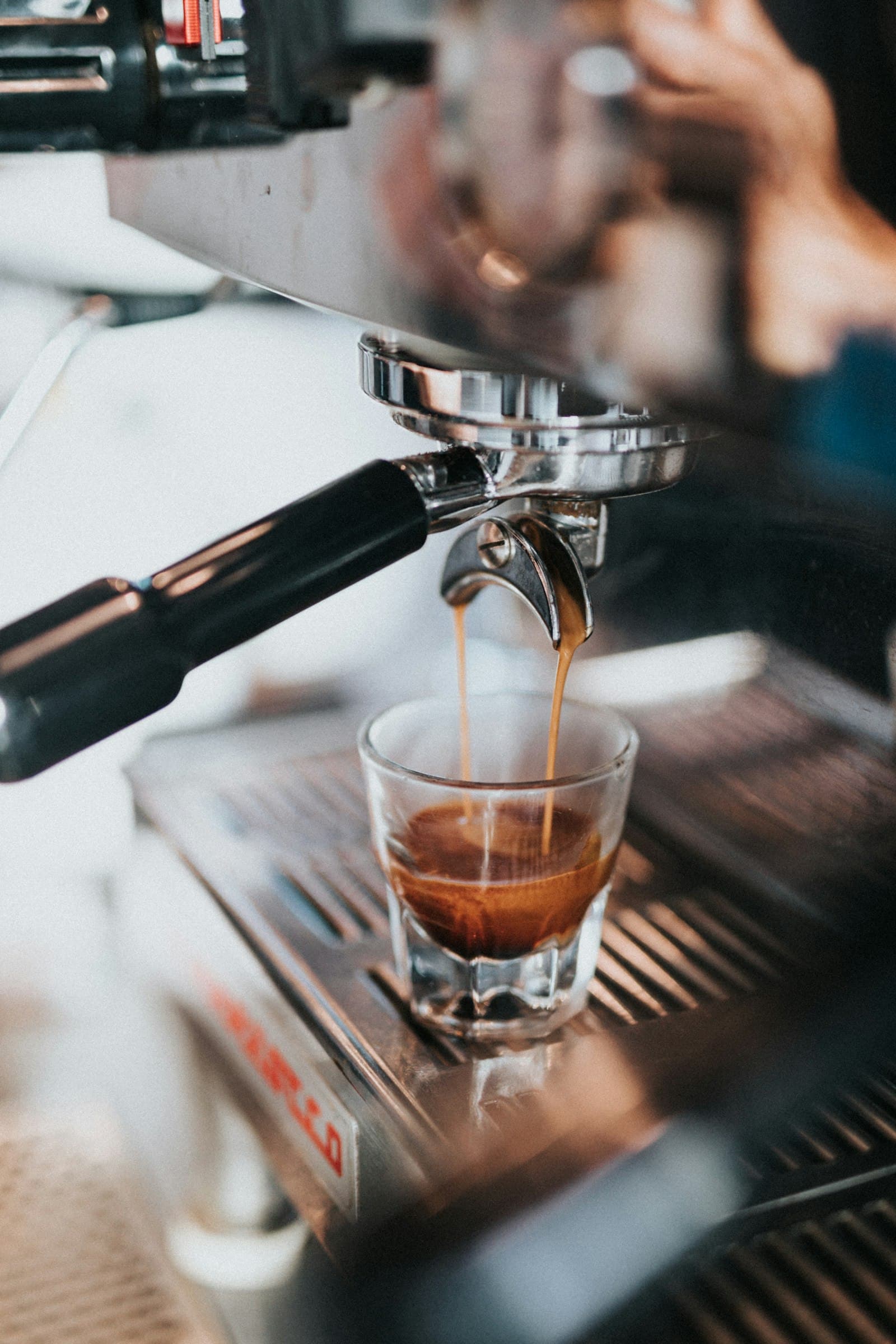
What is dialing in? — tuning the four variables
Dialing in is the work of adjusting extraction variables for a given coffee to balance the taste. Espresso has four main variables to move. You move them “one at a time” and close in while tasting.
- Dose (in): the weight of grounds packed in the basket. 18–20g for a double is the baseline
- Yield (out): the weight of espresso extracted. About twice the dose is the baseline
- Time: the seconds the shot takes. Around 25–30 seconds
- Grind: the most important lever. Finer is slower and stronger; coarser is faster and weaker
Talking in “ratio” is the global standard for espresso: the ratio of yield to dose, with 1:2 (18g in → 36g out) the royal road. A strong, short extraction of 1:1–1:1.5 is a ristretto; a long one of 1:3 or more is a lungo. Water temperature (about 90–94°C) and pressure (about 9 bar) are variables too, but at home it is fastest to leave them alone and focus on the four: grind, dose, yield and time.
The basic recipe (start here)
When in doubt, start from the following “golden ratio.” Use it as your reference point and shift from there while tasting — that is the idea of dialing in.
Double-shot baseline (1:2)
Beans 18g / Water 36g
- Dose: 18g (double basket)
- Yield: 36g (twice the dose)
- Time: 25–30 seconds (from pressing the brew button)
- First drop: ideally begins to fall thin like a “mouse tail” at 5–12 seconds
Espresso is a world of 0.1g. Always weigh the dose and yield on a scale — you cannot reproduce it by eye. Setting a scale under the cup and brewing while measuring the yield (out) is the first step of dialing in.
Working backward from taste — sour? bitter?
The heart of dialing in is “working backward from taste.” Espresso flavor is mostly explained on one axis: under-extracted (not enough out) or over-extracted (too much out).
- Sour, sharp, thin, watery → under-extracted (not enough out). Not enough has dissolved
- Bitter, astringent, lingering, heavy → over-extracted (too much out). Even the off-flavors have come out
- Balanced and sweet → just right. Acidity, sweetness and bitterness are in harmony
Do not jump to “sour = because the bean is a light roast” or “bitter = because it is dark.” With the same bean, an under-extracted shot is sour and an over-extracted one is bitter. Suspect the extraction (= dialing in) before the roast.
A quick fix table — grind is the lead
Once you know the direction of the taste, move a variable to fix it. The top priority is grind. Changing the grind changes the speed of the flow (the resistance), which moves extraction efficiency a lot.
- Sour (under-extracted) → grind finer. The flow slows, extraction rises, and it gets sweeter and deeper
- Bitter (over-extracted) → grind coarser. The flow speeds up, extraction drops, and it cleans up
- Still not right → fine-tune the yield (ratio) or dose. Raising/lowering temperature is the last resort
- Iron rule: move only one variable at a time. Two at once and you lose the cause
Why does grind work? The finer the grounds, the more the water’s path (resistance) increases and the slower the flow, so water and grounds touch longer and more dissolves (= more extraction). Coarser is the reverse. So “sour = want more out = finer” and “bitter = too much out = coarser” is the intuitive rule. We cover the full picture in the grind-size guide.
Time and the signs in the “look”
Extraction time and the “look” of the espresso falling from the portafilter are powerful clues too. Ideally it flows thick like honey in the first few seconds, a rich brown in the middle, turning pale blonde at the end.
- Too fast (done in 15 seconds) → grind too coarse or dose too low. Tends to be thin and sour
- Too slow (40+ seconds, dripping) → grind too fine or dose too high. Bitter and prone to clogging
- Turns pale quickly (early blonding) → a sign of under-extraction. Grind finer
- Spraying or pulsing → possible channeling (see below)
Channeling — the culprit behind “sour and bitter at once”
Sometimes “sourness and bitterness come out at the same time,” or “the numbers are right but it does not taste good.” The culprit is channeling. When the puck is packed unevenly, water carves a “channel” through the point of least resistance and rushes through. That spot over-extracts while the rest stays under-extracted — and the unpleasant flavors coexist.
- Causes: uneven grounds, clumps, a tilted tamp, too much or too little dose
- Fix 1, distribute (WDT): loosen the grounds with a thin needle to even them out. The strongest single move against clumps and unevenness
- Fix 2, tamp level: press straight and even. A tilt is the root of channeling
- Fix 3, correct dose: a dose that is neither too much nor too little for the basket
When the numbers (dose, yield, time) are right but the taste will not settle, the cause is usually “the prep before brewing (how you build the puck).” Just evening the grounds with a WDT tool and tamping level makes it stabilize like a different drink. Before the machine, review your packing first.
Bean freshness and resting
It is easy to overlook, but the bean’s condition also shapes your dial-in. Freshly roasted beans hold a lot of CO2, so the shot runs wild and will not stabilize. Generally, beans rested about 7–14 days after roasting are easiest to handle for espresso. Beans gone too old, on the other hand, lose aroma, and no amount of adjustment fixes a thin cup. Mind the freshness window and dial in with beans in good condition — that is the shortcut.
For milk drinks, push a little stronger
If you are using it for milk drinks like lattes and cappuccinos, the trick is to pull a bit stronger and more concentrated than a perfectly balanced black shot, because milk and ice dilute it and hide the espresso’s character. Push the ratio to a stronger 1:1.5–1:2 and keep the bitterness and body firm, and it stands up to milk. Conversely, for drinking straight, aim around 1:2 with sweetness and balance in mind.
FAQ
What should I do when espresso is sour?
First, try grinding one step finer. Sourness is, in most cases, a sign of “under-extraction (not enough out).” Grinding finer slows the flow, raises extraction, and moves toward a sweet, deep cup. If it lingers, try fine-tuning one at a time: increase the yield (ratio) a little, or raise the water temperature by 1–2°C. If the beans are too freshly roasted, the acidity also runs wild, so resting them a few days helps.
What if espresso is bitter or astringent?
Grinding one step coarser is the basic move. Bitterness and astringency are often “over-extraction (too much out)”; grinding coarser speeds the flow so you can end the shot before off-flavors emerge. Reducing the yield to a shorter ratio (1:2 → 1:1.5) also helps. Dark-roast beans are bitter to begin with, so slightly coarser and shorter is easier to handle.
Are WDT and tamping really necessary?
If the taste will not stabilize even with the numbers matched, then yes. Uneven grounds or clumps cause channeling — water punching through one point — so sourness and bitterness come out at once. Just evening the grounds with a WDT tool and tamping level makes the same recipe surprisingly stable. Improving this “packing” often lifts a shot’s quality more than upgrading to an expensive machine.
Dialing in looks hard but is really a combination of simple rules. Start from the baseline (1:2, 25–30 seconds); if it is sour, go finer; if bitter, go coarser; and move only one variable at a time. Once working backward from taste becomes a habit, you can bend any bean toward your own taste. From your next shot, scale and timer in hand, enjoy the fun of “adjusting.”
Was this article helpful?
Choose & compare
Related links
More articles