Brewing by Extraction Yield and TDS: A Cup You Reproduce with Numbers
"Strength" and "yield" are different things. Aiming for a balanced cup by the numbers
"Strong but lacking," "weak but astringent" — extraction that gets lost on feel alone, sorted out by the two axes of TDS (strength) and yield (how much you dissolved). The golden cup range, and how to translate numbers into taste.
Contents · 6
The same beans, yet the taste differs every time you brew. Chase the cause on feel alone and you get lost. What pros use are two numbers — TDS (strength) and extraction yield (EY). Understand these two axes and you can decide "what to change next" logically.
Two numbers: strength (TDS) and yield (EY)
TDS (Total Dissolved Solids) is the proportion (%) of solids dissolved in the finished coffee. It decides the "strong/weak" when you drink. Extraction Yield, on the other hand, is what % of the bean's compounds you dissolved into the water. This is what decides the "direction" of the taste.
- Low TDS = weak, high = strong (strength)
- Low yield (below ~18%) = under-extraction: sour, salty, lacking
- High yield (over 22%) = over-extraction: astringent, bitter, dry with off-flavors
- Yield 18–22% = the "golden zone" where sweetness and complexity coexist
The golden cup as a standard
The "coordinates of deliciousness" laid out by the SCA (Specialty Coffee Association) is the golden cup. Land within the frame of TDS 1.15–1.35% and extraction yield 18–22% and most people feel it is "well balanced."
The relation is simple: extraction yield (%) = TDS (%) × finished weight (g) ÷ dose used (g). Measure TDS with a refractometer and you can back-calculate the yield.
Translating numbers into taste
Most taste complaints can be explained by too much or too little yield. You only need to remember two directions.
- Sour, salty, watery → under-extracted. Raise the yield (grind finer / raise the temperature / extend the time / agitate)
- Astringent, bitter, mouth-drying → over-extracted. Lower the yield (grind coarser / lower the temperature / shorten the time)
- Taste is good but thin/strong → a strength (TDS) issue. Adjust with the grounds-to-water ratio
Five levers that move the yield
- Grind: the finer, the more surface area, the higher the yield (the most effective)
- Water temperature: the higher, the more readily compounds dissolve, the higher the yield
- Contact time: the longer, the higher the yield
- Agitation (stirring): the stronger, the higher the yield
- Grounds-to-water ratio: mainly moves the strength (TDS)
Should you measure TDS?
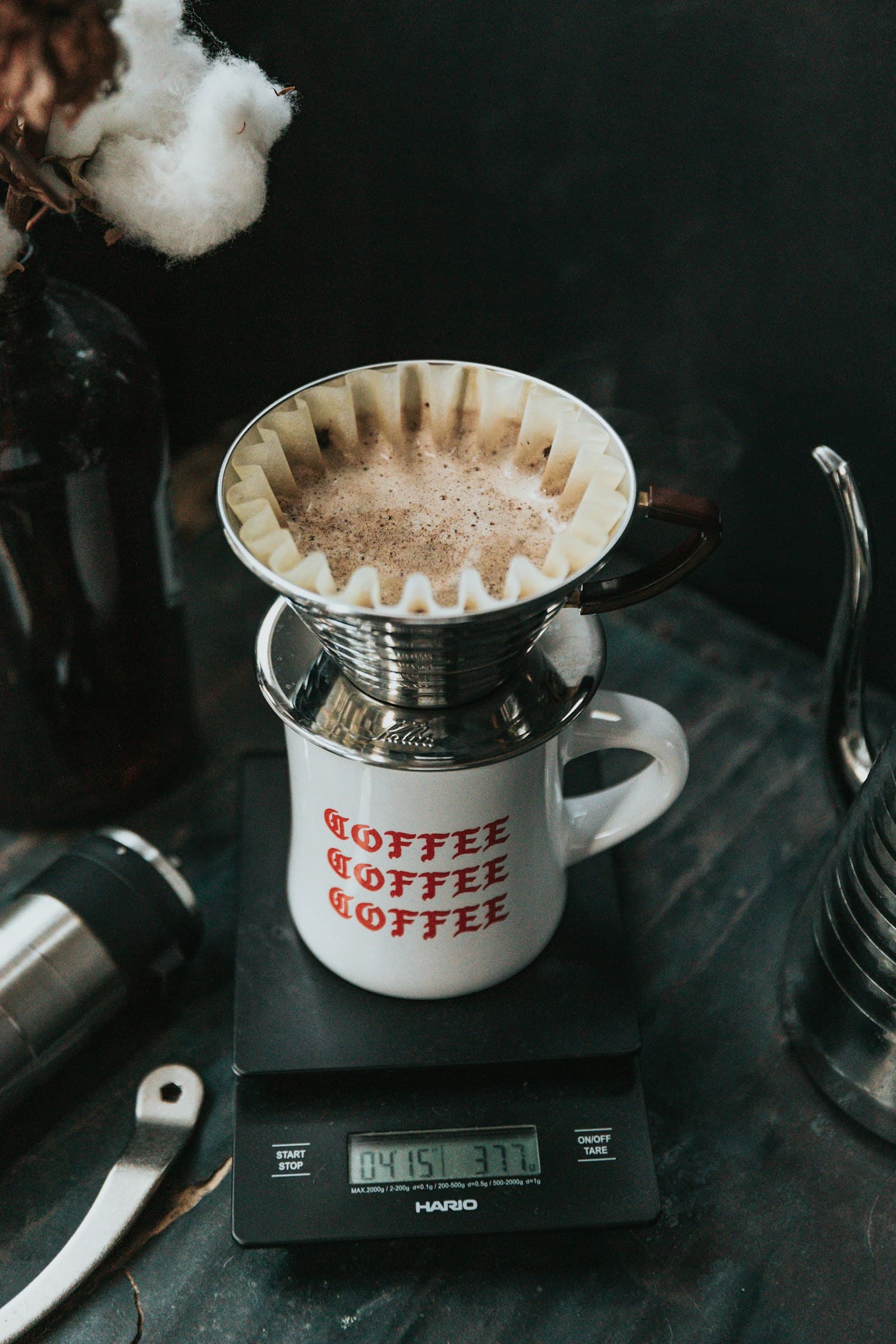
With a refractometer (VST, Atago, DiFluid, etc.) you can manage TDS as an objective number, but it is not essential. For most people the biggest single step is "using a scale." Just fixing the dose, water amount and brew time every time keeps the yield naturally within a certain range and secures 80% of repeatability.
An example baseline ratio (about 1:16.6)
Beans 15g / Water 250g
Once you fix the ratio, next change only one thing. Grind one step finer, and if the acidity settles and it gets sweeter, that is proof the yield went up. Recording "changed → how it changed" this way connects numbers and taste in your head.
First, just noting the dose, water amount and time is fine. A refractometer is the "next move" for when you still want to push further.
FAQ
Do I need a refractometer (TDS meter)?
It is not essential. Affordable phone-linked models (like DiFluid) have appeared, but for most people, fixing the dose, water amount and time with a scale is far better value. Think of a refractometer as a tool for when you want to see objectively "the last few % that feel cannot pin down."
TDS or yield — which do I dial in first?
The standard approach: first get a rough strength (TDS) with the grounds-to-water ratio, then dial in the yield (the taste direction) with the grind. Splitting the roles — strength by ratio, sour/astringent by grind — keeps you from getting lost.
Why is espresso's TDS so high?
Espresso extracts all at once with very little water, so its TDS is 8–12% — several times that of drip (about 1.2–1.5%). Only the scale of strength differs; the idea that "18–22% yield is the golden zone" applies to espresso just the same.
Can under- and over-extraction coexist in one cup?
Yes. When grind particle size is uneven, the fines over-extract and turn astringent while the coarse pieces under-extract and turn sour, so both faults live in a single cup. If it tastes "sour yet astringent," this is often the cause. Before raising or lowering the grind, it helps to suspect whether your grinder grinds uniformly. The more even the particle size, the more honestly you approach your target yield.
Why can't I reproduce the café's taste at home?
Usually it is a difference of "water, freshness and grinder." Even if you match TDS and yield, you won't get the same taste if the water hardness and minerals, the days since roast, and the particle uniformity differ. First match the recipe (ratio, grind, water temp, time) by the numbers, then bring your water and grinder closer to the café's, and the gap narrows sharply. With the same beans, differing freshness also changes how things dissolve — not to be overlooked.
Why doesn't it get sweeter even though I raised the yield?
You may have pushed past 22% into over-extraction. The peak of sweetness sits in the middle of 18–22%; beyond that, astringency and bitterness rise and mask the sweetness. The trick is not to "keep raising" but to turn back at the point where sweetness is greatest. Raise the yield step by step, and when sweetness starts to fade, step back one — it is a search for the summit of that hill.
Should I aim for a different yield with light vs dark roast?
You change how you reach it. Light roast beans are hard and release compounds reluctantly, so aiming a bit higher — finer grind, hotter water, longer — is the rule. Dark roast is porous and releases readily and tips into over-extraction easily, so go a bit gentler — coarser, cooler, shorter. Even for the same "18–22%," the settings that take you there run in opposite directions by roast level.
How exactly do I land in the golden zone with drip?
For home drip, start with this baseline: "medium-fine grind, water 90–93°C, 15–16 times the dose in water, 2.5–3.5 minutes total." This range tends to land roughly in 18–22% yield. After that, the trick is to move only one thing at a time. If it is sour or lacking, grind a little finer or raise the temperature; if it is astringent or heavy, go a little coarser or lower the temperature. Even without a refractometer, holding this baseline and the "one variable at a time" rule gets you plenty close to the golden zone. Numbers are not a replacement for feel but a map that speeds up your aim.
Grasp extraction by the "numbers" and your improvement accelerates at a stroke. Not denying feel, but giving feel coordinates — that is the tool of TDS and yield.
Was this article helpful?
Choose & compare
Related links
More articles
The Science of Extraction — What, and How, Hot Water Draws Out of Coffee: Dissolution, Diffusion and Yield
BrewingComplete Guide to Nel Drip — The Kissaten’s “Velvety Cup” at Home
BrewingThe Complete Guide to Dialing In Espresso: The Science of Fixing Sour and Bitter Yourself
BrewingThe Coffee-to-Water Ratio: Set Your Flavor by the Numbers, From One Cup to a Crowd