The Science of Extraction — What, and How, Hot Water Draws Out of Coffee: Dissolution, Diffusion and Yield
Two yardsticks — strength (TDS) and extraction yield — the five levers that decide taste, and the boundary between “under-extraction” and “over-extraction,” unraveled through physics and chemistry
Put ground coffee in a dripper and pour hot water. Within this single, simple act, a surprisingly precise physics and chemistry is happening. What, in what order, and how much is the water drawing out of the grounds? Understand that, and a cup that was “somehow good / bad” becomes something you can speak of in terms of “why it turned out that way.” This article traces the phenomenon of extraction through three lenses — two yardsticks of strength (TDS) and yield, the five levers that steer taste (grind, water temperature, time, ratio, water), and the boundary between “under-” and “over-extraction.” By the end, adjusting taste should have become design, not guesswork.
Contents · 12
- What extraction is — “dissolving” and “carrying out”
- Strength (TDS) and yield — two yardsticks
- Extraction has an “order” — the speed at which compounds dissolve
- The five levers that decide taste
- Lever 1: grind — surface area, the biggest variable
- Lever 2: water temperature — the energy that moves molecules
- Lever 3: time and contact — length and “agitation”
- Lever 4: the coffee-to-water ratio
- Lever 5: water — the nature of the solvent itself
- Under- and over-extraction — reading the boundary
- To “design” extraction — reproducing a cup
- Frequently asked questions
Put ground coffee in a dripper and pour hot water. Within this single, simple act, a surprisingly precise physics and chemistry is happening. What, in what order, and how much is the water drawing out of the grounds? Understand that, and a cup that was “somehow good / bad” becomes something you can speak of in terms of “why it turned out that way.” Extraction is the step of dissolving the compounds contained in ground coffee into water. How well it goes is decided by factors like the coffee-to-water ratio, the grind and the water temperature. This article traces, through the eyes of science, two yardsticks — strength (TDS) and yield — the five levers that steer taste, and the boundary between “under-” and “over-extraction.”
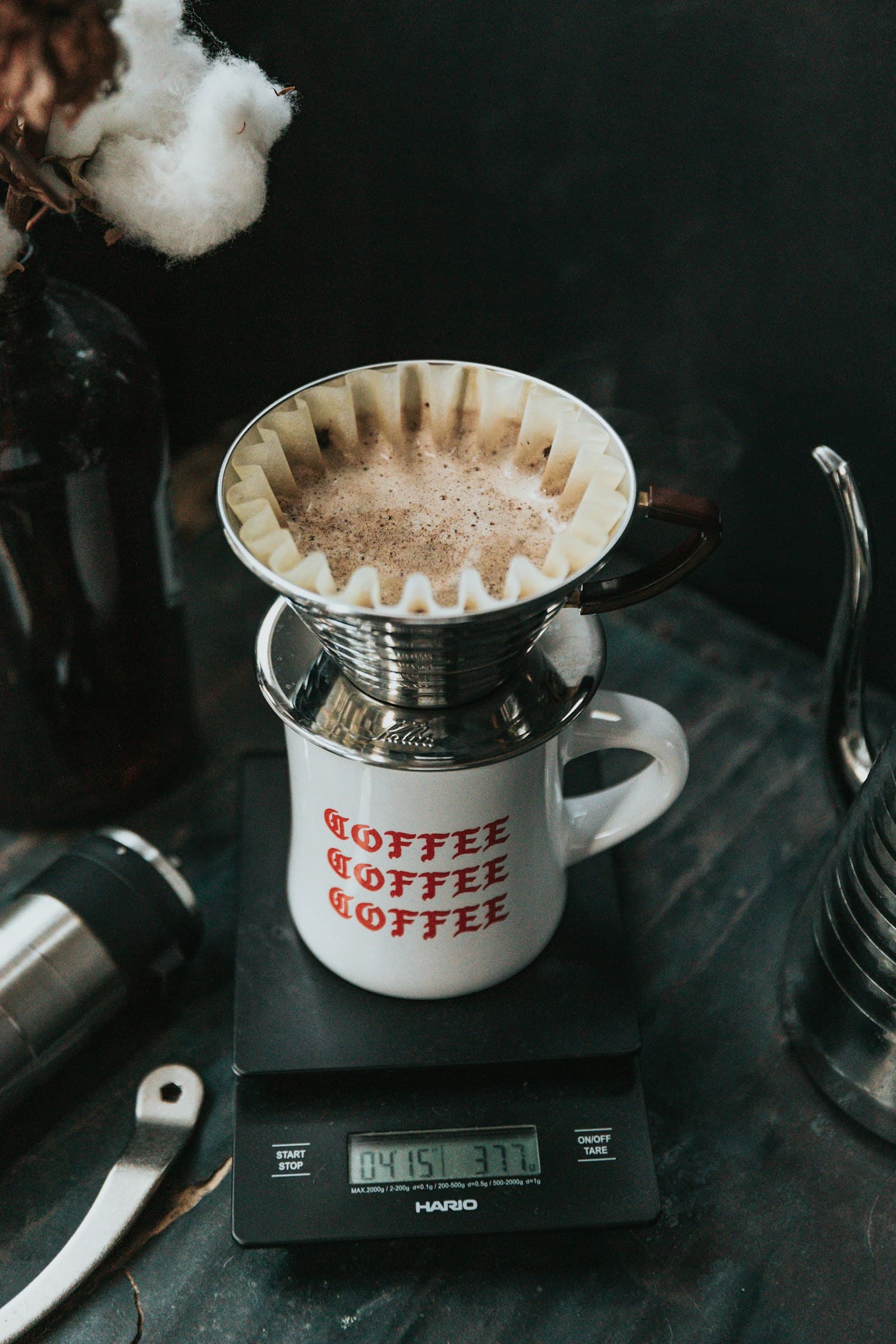
What extraction is — “dissolving” and “carrying out”
Extraction, put simply, is “dissolving the soluble compounds contained in ground coffee into water.” This phenomenon consists broadly of two physical processes. One is “dissolution” — the acids, sugars, caffeine and so on at the surface and inside of the grounds dissolving into the water. The other is “diffusion (mass transfer)” — the dissolved compounds moving from around the concentrated grounds toward the thinner water and being carried out into the whole. Of a roasted bean, only about 30% is soluble compounds that dissolve into water; the rest is an insoluble skeleton of fiber and the like. And what we find “delicious” is when only a further portion of those soluble compounds is drawn out. Neither too much nor too little — extraction is the craft of stopping at that targeted “amount drawn out.”
Of the ground coffee, only about 30% by weight dissolves into water. The remaining roughly 70% is an insoluble skeleton such as cellulose. And what is drawn out into a delicious cup is a further portion of that soluble part — about 18–22% seen across the whole bean. In other words, most of the bean never makes it into the cup. This sense of “drawing out only a part, on purpose” is the starting point for understanding extraction.
Strength (TDS) and yield — two yardsticks
Indispensable when talking about extraction are two yardsticks: “strength” and “yield.” They are often confused, but they measure entirely different things. Strength (TDS = total dissolved solids) is the proportion showing “how much dissolved matter is in the finished coffee.” It is, so to speak, the “thickness / strength” of a cup, and the higher the number, the stronger the taste feels. Yield (extraction yield), on the other hand, is the proportion showing “what percentage of the grounds you managed to dissolve into the water.” This expresses not the “thickness” of taste but “which compounds you drew out.” The “golden cup” taken as a guide in the specialty world is a strength of roughly 1.15–1.35% and a yield of 18–22%. These two are independent axes — for instance, “strong but under-extracted” (high strength, low yield) or “thin yet over-extracted” (low strength, high yield) are both possible. That is exactly why being mindful of both is the key to adjusting taste.
- Strength (TDS): the “thickness / strength” of a cup. The proportion of dissolved compounds. Moves mainly with the coffee-to-water ratio
- Yield: what percentage of the grounds you drew out. “Which compounds you got out.” Moves mainly with grind, water temperature and time
- Golden-cup guide: strength 1.15–1.35% / yield 18–22%
- Two separate axes: “strong yet under-extracted” and “thin yet over-extracted” are both possible
This chart shows how much the strength (TDS) of a cup differs by extraction method. Where drip and French press are around 1.3%, espresso is around 9% — nearly seven times as strong. Espresso is “strong” because high pressure concentrates the compounds into a small amount of water in a short time. Even the same “coffee” differs by an order of magnitude in strength. What matters here is that high strength does not equal good extraction. Espresso’s yield stays within the proper range even at high strength, and the earlier point — that thickness (strength) and how much you drew out (yield) are separate things — comes back into play here. The figures are only general guides and shift with the recipe.
Extraction has an “order” — the speed at which compounds dissolve
Ground coffee touched by hot water does not release all its compounds at once. Each compound differs in the “speed at which it dissolves,” and there is a clear order. First, the most easily dissolved acidity compounds and fruity aromas come out quickly. Next, a little later, sugar-derived sweetness, caramel notes and balance-carrying compounds come out. And last, the hardest-to-dissolve bitterness and astringency compounds (like tannins) come out slowly over time. This order is the very core of understanding extraction taste. Stop too early and you get a “sour” cup where only acidity stands out; draw out too much and you get an “harsh” cup where bitterness and astringency have come out. What you aim for is stopping at the “just-right middle” where sweetness has come out fully and bitterness and astringency have not come out too much. Extraction is the work of catching the best single point on this time axis.
- First (fast): acidity, fruity aromas. The most easily dissolved
- Middle: sweetness, caramel notes, body and other balance-carrying compounds
- Last (slow): bitterness, astringency (tannins, etc.). The hardest to dissolve
- The target: stop at the “middle” where sweetness has come out fully and bitterness and astringency have not come out too much
Remember this “order of dissolution” and adjusting taste becomes logical. Sour, thin, unsatisfying → not enough drawn out (under-extraction), so go toward drawing out more. Bitter, astringent, heavy aftertaste → too much drawn out (over-extraction), so go toward restraining it. The “five levers” in the next chapter are all, if you think of them, adjustments to increase or decrease this amount drawn out — which makes it all click.
The five levers that decide taste
The variables we can control in extraction come down, in the end, to five: grind, water temperature, time (and contact), ratio, and water. These five levers all work in the direction of raising or lowering the “yield (amount drawn out).” Grind finer and yield rises; lower the water temperature and yield falls. When the taste won’t come out as you want, rather than changing your method blindly, think in terms of “which lever, in which direction do I move it,” and extraction becomes a reproducible craft all at once. Let us look at them one by one.
Lever 1: grind — surface area, the biggest variable
Of the five levers, the one that works most powerfully is the grind (particle size). The finer you grind the bean, the more surface area touches the water, and the faster and more compounds dissolve out. Grind coarser and the surface area shrinks, and extraction becomes slow and restrained. Espresso is ground extra-fine and French press coarse precisely because each optimizes surface area to its extraction time and pressure. Another important thing is “uniformity.” When particle sizes are scattered, the fine particles (fines) over-extract and turn bitter while the coarse particles under-extract and turn sour, and their average is a muddy taste. Good grinders are prized because they even out the particles and reduce excess fines. Grind is explained in detail in the grind-size guide.
Lever 2: water temperature — the energy that moves molecules
Water temperature is the very energy that dissolves compounds out. The higher the temperature, the more actively the molecules move, and the faster dissolution and diffusion proceed, so yield rises. Generally, around 90–96°C is taken as standard for drip. Too hot and you draw out even bitterness and astringency all at once, tending toward over-extraction and making the taste prickly. Too cool and dissolution doesn’t proceed, leaving an under-extracted taste of acidity alone with no sweetness riding on it. Draw out light-roasted, hard beans firmly at a slightly higher temperature, and restrain bitterness in dark-roasted, porous, brittle beans at a slightly lower one — the trick is choosing the temperature to suit the bean. Designing water temperature is collected in the deep dive on water temperature.
Lever 3: time and contact — length and “agitation”
The third lever is the “time” that hot water and grounds are in contact, and the way they touch — that is, “agitation (stirring).” The longer the contact time, and the more the water’s flow is disturbed (turbulence arises) by pouring or stirring, the better compounds are drawn out and the higher the yield. Placing a “bloom” in drip, or changing how you pour, is to control this contact. The thing to watch here is “channeling” — where a passage for the water forms in the bed of grounds, the water flows only through there, and the other grounds are left behind. When channeling happens, the grounds along the passage over-extract and the left-behind grounds under-extract, blurring the taste. Grinding evenly, leveling the bed of grounds flat, and pouring gently over the whole are the basics for preventing it.
Channeling is a great enemy that muddies taste in both drip and espresso. Its causes are unevenness in the grounds (uneven fines), a tilted bed, rough pouring, and so on. The countermeasures are three: “an even grind,” “leveling the surface of the grounds flat,” and “pouring gently in circles from the center.” The same grounds and the same water volume can taste different from the pour alone, because the evenness of this contact changes.
Lever 4: the coffee-to-water ratio
The fourth is the ratio of grounds to water. This is mainly the lever that decides a cup’s “strength (thickness).” More grounds and less water makes it strong; fewer grounds and more water makes it thin. Commonly used is around 1:15–1:16 (15–16 water to 1 grounds); adjust to 1:14 if you like it strong, 1:17 if you like it crisp. But the ratio affects not only strength but yield too. Because even with the same amount of grounds, increasing the water works in the direction of washing out more compounds. That is exactly why, when you change the ratio, the trick is to fine-tune grind and time as well and re-balance strength and yield. The thinking on ratio is covered in detail in the golden coffee-to-water ratio.
Lever 5: water — the nature of the solvent itself
Easily overlooked, but over 98% of a cup is water. The nature of that water — its hardness and mineral content — is a proper lever that steers extraction too. The magnesium and calcium in water bind with coffee’s flavor compounds and help extraction, and moderate minerals lend depth to the taste. Bicarbonate (alkalinity), on the other hand, has a buffering action that cancels acidity, and too much blurs coffee’s bright acidity into a flat taste. Pure water (distilled) doesn’t extract well, and conversely water too high in hardness turns muddy — which is why “water with moderate minerals” suits coffee. Choosing water is explained in how water quality changes coffee.
Under- and over-extraction — reading the boundary
With the knowledge so far, you can “diagnose” the state of extraction from the taste. Sour, salty, thin and unsatisfying, taste that vanishes at once — these are signs of not enough drawn out, that is, “under-extraction.” Since acidity comes out first, stopping there leaves acidity alone. Conversely, bitter, astringent, lingering on the tongue, heavy aftertaste, a hollow emptiness — these are signs of drawing out too much, “over-extraction”: a state where you have drawn out even the last-emerging bitterness and astringency compounds. And when sweetness rides on, the balance of acidity and bitterness is struck, and the aftertaste continues cleanly sweet — that is extraction as intended. The “brewing control chart” that pros use captures this strength (vertical axis) and yield (horizontal axis) in two dimensions, a tool for visualizing which zone your cup sits in. It translates the words of taste into cause and remedy.
- Sour, thin, unsatisfying → under-extracted. Go toward grinding finer / raising water temperature / extending time
- Bitter, astringent, heavy aftertaste → over-extracted. Go toward grinding coarser / lowering water temperature / shortening time
- Salty, taste is gaunt → leaning under-extracted. Make adjustments that raise yield
- Just right (sweet, balanced, clean aftertaste) → record that recipe and reproduce it
The iron rule when adjusting taste is “move only one lever at a time.” Tinker with grind, water temperature, time, ratio and water all at once and you lose track of what worked. Change just one first, confirm the change in taste, and record it. This steady one-step-at-a-time is what turns extraction from “by chance” into “a reproducible craft.”
To “design” extraction — reproducing a cup
The greatest lesson the science of extraction teaches is that “a delicious cup can be reproduced by design, not luck.” Indispensable for that is capturing it in numbers. Weigh grounds and water on a scale (ratio), measure time with a timer, and decide grind and water temperature. Then move only one lever at a time, taste, and record. This accumulation builds a recipe all your own. Sense and science are not at odds. Rather, when you can back up why you felt something with science, your senses grow sharper. A systematic recipe like the 4:6 method, and the thinking on strength and yield, are all tools for this “designing and reproducing.” From your next cup, do brew with numbers at hand.
Frequently asked questions
Why does the taste waver even with the same bean and same gear?
Because one of the five levers (grind, water temperature, time, ratio, water) is slightly different each time. Especially prone to wavering are eyeballed dose, water temperature, and how you pour (contact time and agitation). Just weighing grounds and water on a scale, keeping the water temperature constant, and matching how you pour makes the taste astonishingly stable. Extraction is delicate, so small differences move the yield and change the taste. Put the other way: fix the variables one by one and the taste becomes reproducible.
Can I measure “yield” at home?
Measuring it accurately needs a device called a TDS meter (refractometer), but you don’t necessarily have to put it into numbers at home, because taste itself is the best sensor. Sour or thin means under-extracted (low yield); bitter or astringent means over-extracted (high yield) — you can read the excess or shortfall of yield well enough from taste. If you want to manage it by numbers or take it to the limit, a TDS meter lets you calculate yield from strength, raising the reproducibility of your recipe a notch.
Are “strong coffee” and “strong extraction” the same thing?
No. “Strong” is about strength (TDS) — the “thickness / intensity” of how much compound is dissolved in a cup. “Strong extraction (much drawn out)” is about yield — what percentage of the grounds you dissolved. Increase the grounds and strength rises, but yield does not necessarily rise. Conversely, a state of “thin yet over-extracted (astringent)” is possible too. Separate them — thickness by the ratio, how much drawn out by grind, water temperature and time — and adjusting taste becomes far easier.
How do I make bitter coffee sweeter?
Bitterness and astringency are signs of “over-extraction” that come out last, so adjust in the direction of restraining what is drawn out. Concretely: grind a little coarser, lower the water temperature a little (to around 90°C), or shorten the extraction time — any one of these. Try just one at a time first. If it still stings, the bean itself may be too dark a roast. Conversely, if sourness bothers you, that is under-extraction, so move the other way — grind finer, raise the water temperature, extend the time.
Does adding more water make it thinner? What happens to yield?
Increase only the water without changing the grounds and a cup’s strength (thickness) falls and it becomes “thin.” Yield, on the other hand, tends to rise, because more water washes out more compounds. In other words, you can end up with a cup that is “thin yet drew out more (in some cases leaning over-extracted).” It is a fine example of thickness and how much you drew out being separate things. If thinness bothers you, reduce the water or increase the grounds; if astringency emerges, adjust the yield side with grind or time.
Is the thinking on extraction different for espresso and drip?
The basic principles (dissolution and diffusion, yield and strength, the order of dissolution) are the same, but the conditions differ greatly. Espresso applies around 9 bar of pressure and passes a small amount of water through extra-finely ground coffee in 20–30 seconds, so strength is very high (around 9%). Drip passes water slowly through coarser grounds by gravity alone, so strength is low (around 1.3%). Pressure, grind, time and water volume are all completely different, so how the levers work changes too, but the goal — “stop at the middle where sweetness comes out” — is shared.
Behind the casual act of pouring hot water, compounds dissolve, diffuse, and flow out in order — from acidity to sweetness, then bitterness. Extraction is the craft of catching the single most delicious point in that flow and stopping there. The five levers — grind, water temperature, time, ratio and water — are all knobs for adjusting the “amount drawn out,” and the result called taste always has a cause. Capture it in numbers, move one at a time, and record — a cup designed that way is not a fluke but your recipe, one you can summon back anytime. The science of extraction is not a denial of the senses. Rather, it is a reliable ally for putting the reason for a cup’s taste into words and making the next cup even better.
Was this article helpful?
Choose & compare
Related links
More articles
Complete Guide to Nel Drip — The Kissaten’s “Velvety Cup” at Home
BrewingThe Complete Guide to Dialing In Espresso: The Science of Fixing Sour and Bitter Yourself
BrewingThe Coffee-to-Water Ratio: Set Your Flavor by the Numbers, From One Cup to a Crowd
BrewingWater Changes the Taste: The Science of Coffee and Water