Brewing with a Siphon: Between Spectacle and Practicality
More than looks — the science of vapor-pressure extraction and where it fits at home
You have seen "that apparatus" at a café, but few brew with it at home. We explain the siphon's characteristic clean extraction, the appeal of the "spectacle," the points where beginners stumble, and frequently asked questions.
Contents · 7
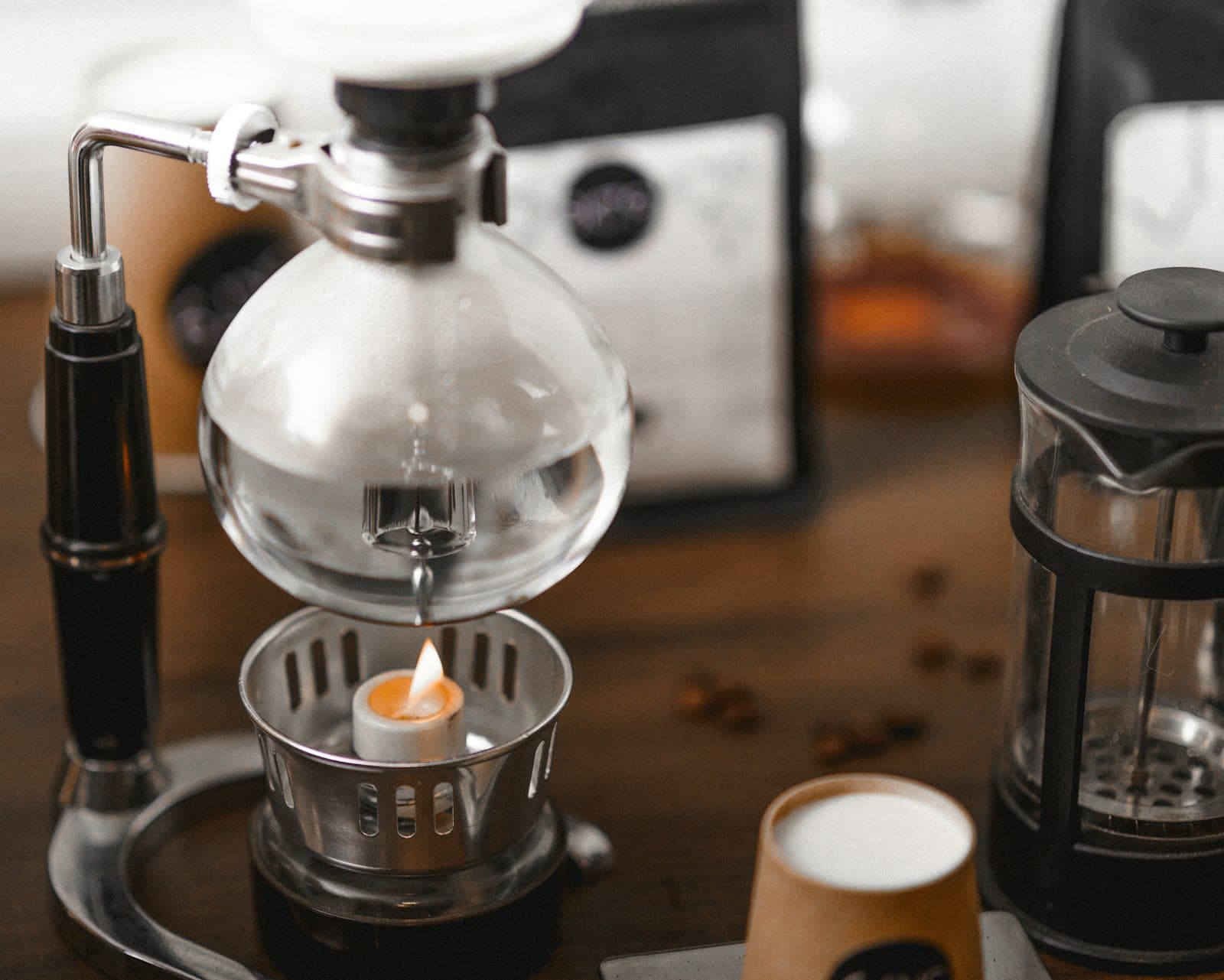
The siphon (a.k.a. the vacuum coffee maker) is a vapor-pressure brewer invented in 19th-century Europe. You boil water in the lower flask, vapor pressure pushes it up, and when you cut the heat the vacuum draws it back down. Both the mechanism and the choreography are high in "spectacle," which is why it tends to be shunned — but it is actually a highly repeatable brewing method.
Taste traits: between paper and press
Because the siphon uses a cloth filter, more oils pass through than with paper. The result is a "middle taste" with a body like a French press, yet keeping a cleanness close to paper. It shows its true worth with fruity light roasts from Ethiopia and Kenya.
The basic recipe
- Beans: medium-fine (a little finer than a V60)
- Ratio: 1:14–1:15 (slightly strong)
- Temperature: let the rise happen naturally, stir up top
- Time: cut the heat 60 seconds after it rises
Basic recipe for two cups
Beans 20g / Water 280g
Technique tips: three stirs
As soon as the water has fully risen into the upper funnel, add the grounds immediately. With a long spoon, quickly trace a "figure 8" for 10 seconds. Wait 30 seconds for a second stir, and a third just before cutting the heat. Three stirs minimize extraction unevenness, and the vacuum from the moment you cut the heat draws it down without leaving off-flavors.
Always store the cloth filter wet, refrigerated, after use. If it dries out, bacteria multiply and a "cloth smell" stronger than any papery smell emerges. Replace one filter about every 2–3 months as a guide.
Choosing the heat source: alcohol lamp, beam heater or gas
A siphon's repeatability actually changes a lot with the heat source. The steadier the heat, the more consistent the timing of the rise and your stirring — and the less the taste wobbles.
- Alcohol lamp: the classic that comes with it. Full marks for atmosphere, but weak and wind-sensitive, so the rise takes time
- Beam (halogen) heater: strong, steady heat and a fast start. For home use, this is the most practical
- Gas (a cassette-burner torch): the most powerful and fast, but heat control is touchy and easy to rush. For the intermediate
If you "want to brew steadily at home," a beam heater is the only choice. Treat the alcohol lamp as for show and you will feel more relaxed.
Should you use it at home?
Honestly, it is not suited to a daily routine. It needs an open flame, the glass breaks easily, and cleaning is a chore. What makes it worth owning anyway is "the spectacle when guests are over" and "drawing the most out of a special bean." Positioned as a special-occasion V60, it adds range to your home coffee experience.
Common failures and fixes
Cloudy / off-flavors
The main causes are over-stirring or letting it boil too long up top. Keep stirs short and be strict about cutting the heat 60 seconds after the rise. A "cloth smell" from the filter also causes cloudiness, so store it wet and replace it regularly.
Thin / underwhelming
The grind may be too coarse or the ratio too weak. Go medium-fine and make the ratio a slightly strong 1:14–1:15. Adding the grounds only after the water has fully risen matters too.
The water will not fully rise into the upper funnel
Too little heat, or a loose or worn gasket (the joint between top and bottom). Switch to a stronger beam heater, or inspect and replace the gasket.
FAQ
Can I heat it on an induction (IH) cooktop?
No. The siphon is glass, so you heat it with an open flame (alcohol lamp or gas burner) or a beam (halogen) heater. Induction works by heating a metal pot, so it cannot be used with a glass flask.
Can I brew just one cup?
It struggles to. The structure needs a certain minimum volume, and with too little the water will not fully rise and stays unstable. A 3-cup siphon brewing two cups (around 20g of beans and 280g of water) is the most stable. If you usually brew for one, an AeroPress or a V60 suits you better.
Can I use filters other than cloth?
Some models offer adapters for paper or metal filters. If the cloth upkeep (storing it wet, replacing it regularly) is a hassle, a paper-capable model is an option. That said, the siphon's signature "body and cleanness together" comes through best with a cloth filter.
How does a siphon differ from drip in taste?
A siphon is a hybrid of "full immersion plus a cloth filter." Because the grounds soak entirely in the water like a French press, it gives rich body and aroma, while the final cloth filtration keeps a cleanness close to paper drip. So it has more aroma and body than drip, yet is clearer than a press — that middle ground is its strength. Extracting all at once at high temperature also makes its aromatic vividness stand out.
Why is a siphon called a "vacuum" brewer?
Because it brews by manipulating "air pressure" through heating and cooling. Heat the lower flask and the air and vapor inside expand, pushing the water up into the upper funnel. There it mixes with the grounds and extraction proceeds; cut the heat and the lower flask cools, the pressure drops (a partial vacuum forms), and the brew is drawn back down. From this "drawing down by vacuum" it is called a vacuum coffee maker.
How do I clean and maintain it?
The rule is "neutral detergent for the glass, water only for the cloth." Wash the flask and funnel gently with a neutral detergent, avoiding abrasives and metal scourers that scratch glass. The cloth filter absorbs detergent odors, so rinse it with hot water to remove grounds and always store it wet, sealed and refrigerated. Letting it dry causes the cloth smell. Replace the cloth about every 2–3 months as a guide.
Which beans and roast levels suit a siphon?
Vivid light-to-medium roasts show best. Fruity beans like Ethiopia and Kenya in particular reveal their true worth through the high-temperature extraction and strong aromatics. A medium-dark roast, on the other hand, brings out richness and sweet aroma — a good match for an after-dinner cup. Because the cloth filter keeps body, even a light roast that feels thin on paper becomes a satisfying cup.
What is the siphon's history? When was it born?
Its prototype was born in early-19th-century Europe. By the 1840s, patents for vacuum coffee makers appeared in France and Germany, and its beautiful choreography spread to homes and cafés in many countries. In Japan too it was embraced alongside the Showa-era kissaten culture, and today "siphon = a symbol of the coffee house" is firmly established. It looks high-tech at a glance, but it is in fact a venerable brewing method with over 150 years of history.
A siphon is not "difficult" — it is a brewer whose variables are visible. Steady the heat and keep the stirring and timing constant, and it pours a surprisingly repeatable, clean cup. Start with one special light roast and enjoy the whole choreography.
Was this article helpful?
Choose & compare
More articles