5 Steps to Put Your Taste Into Words
Expressing "delicious" as tasting notes
Learning path · Beginner/Chapter 2
One of the 7 chapters in this level. Tap the button on the right when you finish reading to log your progress.
The words coffee people use — "berry-like," "a nutty finish." These are not talent; they are a describing skill anyone can build with practice.
Contents · 10
- Step 1: Drink it at different temperatures
- Step 2: Evaluate four elements in order
- Step 3: Map it to a food you associate
- Stuck for words? A starter list by category
- A worked example: how to write a tasting note
- Step 4: Keep records for 3 months
- Step 5: Brew the same beans different ways
- Try mimicking a pro "cupping"
- Common stumbles
- FAQ
Coffee has over 800 aromatic compounds, but the human brain cannot remember them without turning them into words. Conversely, once you can verbalize, anyone can write pro-level tasting notes. It is less about the palate itself than about vocabulary and habit.
Step 1: Drink it at different temperatures
Taste one cup at three temperatures (hot, warm, cooled). As it cools, acidity and sweetness rise and different flavors emerge. This alone reveals your preferred temperature range.
Step 2: Evaluate four elements in order
- Aroma: bring your nose close — what does it smell like?
- Acidity: strong or weak, and what kind (citrus, berry, apple, wine)
- Body: light or heavy, tea-like or milk-like
- Finish: what lingers afterward, and how long
Step 3: Map it to a food you associate
If you sense "berry-like," is it blueberry? Raspberry? Strawberry? Go one step further to a state like "blueberry jam" or "frozen blueberries" for a reproducible note.
Referring to a flavor wheel helps verbalization. Tracing from the central big categories out to specific examples is the SCA-recommended method.
Stuck for words? A starter list by category
When "no words come," do not search from scratch — just pick the closest item from the categories below. The trick is to first land on the big group (fruit, floral, etc.), then descend to a specific name.
- Fruit: lemon, orange (citrus) / blueberry, strawberry (berry) / apple, peach (stone fruit)
- Floral & sweet aromas: jasmine, black tea, rose / honey, maple, brown sugar
- Nut & cacao: almond, hazelnut / milk chocolate, dark chocolate
- Spice & other: cinnamon, clove / caramel / earth, mushroom (earthy)
- Texture words: silky, creamy, light, juicy, dry
A worked example: how to write a tasting note
You do not need polished prose. Just jotting a word or two for each of the four elements, as below, makes a perfectly good note. There is no "right answer" to hit — the trick is to write down whatever you associate. As an example, here is a note imagining a light-roast Ethiopia. A string of single words is plenty at first. Write up many cups in the same format and your past notes become "a dictionary just for you," and your vocabulary for describing a new cup keeps growing.
- Coffee / roast: Ethiopia Yirgacheffe / light roast (day 8 from roasting)
- Aroma: jasmine, lemon, a black-tea-like brightness
- Acidity: bright and light, close to lemon tea, not piercing
- Body / finish: light. The aftertaste fades cleanly, with a honey-like sweetness at the end
- Overall: a cup for the morning. As it cools an orange sweetness emerges and I like it even more
Step 4: Keep records for 3 months
Tasting is "a conversation with yourself." Even if all you can write the first month is "all delicious," after three months your vocabulary suddenly grows. Judging from memory alone is impossible — keep records in an app.
Step 5: Brew the same beans different ways
Brew the same beans with pour-over and a French press and the taste changes as if they were different coffees. This is how you feel that "extraction creates flavor," and your preferred brewing style comes into view.
Try mimicking a pro "cupping"
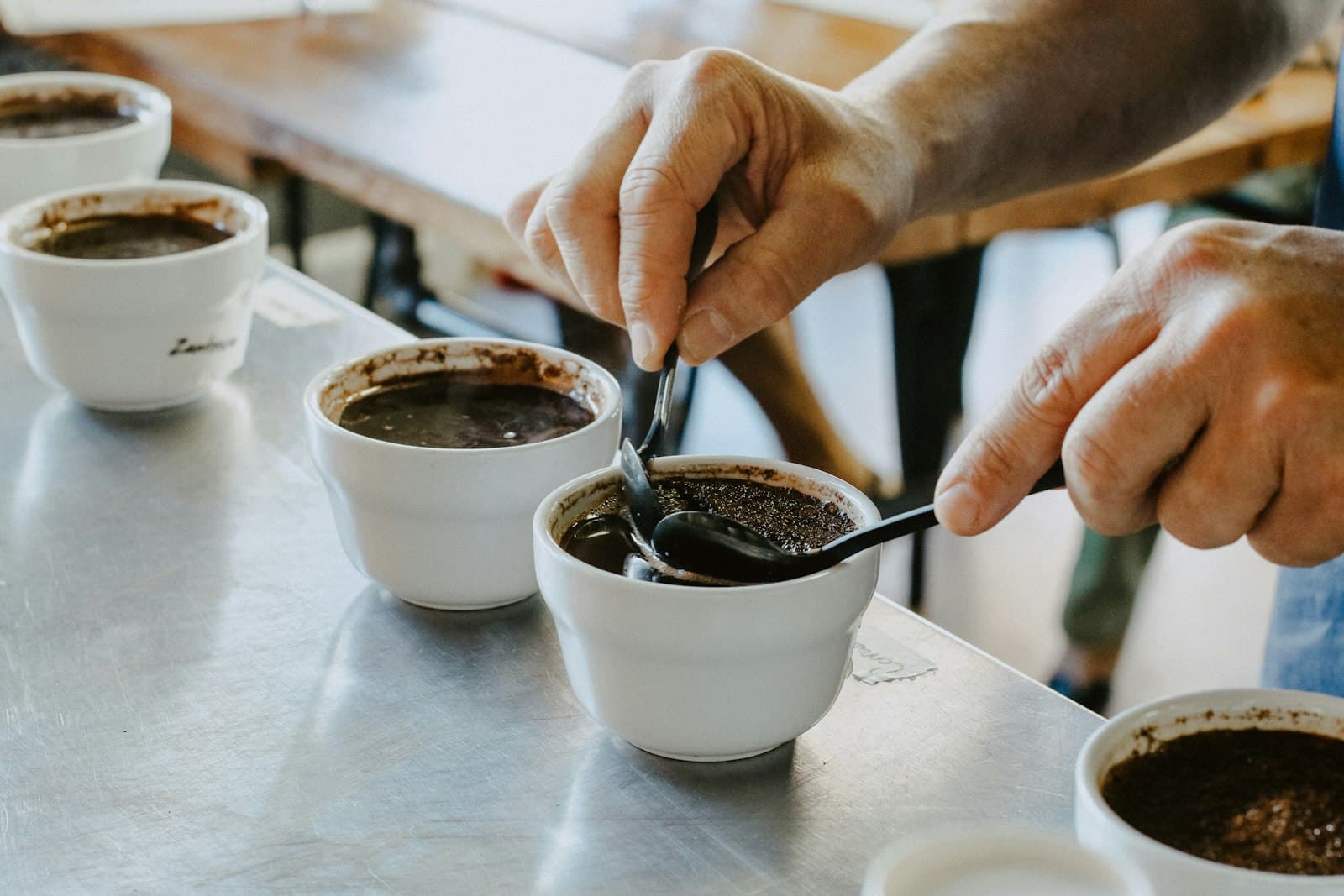
Cupping is how buyers and roasters worldwide evaluate taste with a shared procedure, and it is easy to mimic at home. Put coarse grounds straight into a cup, pour 92–93℃ water and wait 4 minutes. Break the surface layer (crust) with a spoon to smell the aroma, skim the foam, and once it cools a little, slurp sharply with a spoon.
Slurping turns the coffee into a mist that spreads across your mouth and deep into your nasal cavity, capturing aroma and taste at once. Do not worry about manners — slurp hard.
The point is to line up several under the same conditions. One alone gives no reference and will not become words, but with 2–3 side by side you can speak in differences: "this one is brighter," "this one is heavier." Difference is born from comparison.
Common stumbles
- Trying to guess the "right answer" → notes are subjective; whatever you associate is correct
- Judging only while hot → individuality shows as it cools; drink it to the end
- No vocabulary → just pick from the wheel's big categories (fruit, floral, nut, etc.)
FAQ
Can I verbalize even without confidence in my palate?
You can. This is not about a sharp palate but about "vocabulary" and "the habit of recording." Map flavors from the wheel's big categories and keep notes for three months, and anyone's vocabulary grows.
How many should I compare at once?
Two or three is best. Too many and your palate tires and the differences blur. Line up contrasting beans (bright acidity vs. heavy richness) and the gap is easier to put into words.
What beans are good to practice with?
Light-to-medium single origins with clear character are good for practice. Dark-roast blends melt the elements together and are hard to break down. Start with an "obvious and showy" cup like an Ethiopia or Kenya and your vocabulary grows more easily.
Can I practice with drinks other than coffee?
It actually helps. Practicing "putting aroma into words" with aroma-rich foods and drinks — wine, black tea, chocolate, fruit — carries straight over to coffee. The very habit of asking "what does this smell like?" in daily life becomes the foundation of tasting. Black tea in particular shares a lot of vocabulary with coffee, like floral and fruity, which makes it an ideal way in.
Keep it up for three months and words like "this is strawberry-jam-like" or "an Earl Grey aftertaste" come naturally. Tasting is not talent — it is the accumulation of records and comparison.
Learning path · Beginner Chapter 2 — Up next
Chapter 3 · A Five-Minute Morning Routine for a Better Cup Every DayWas this article helpful?
Choose & compare
Related links
More articles
Cold Brew vs Iced Coffee: What Is the Difference
How-toMaking Blends at Home: 3 Basic Recipes and How to Build Them
BeansThe Science of Coffee Aroma — The Story of the “800 Molecules” Rising From a Single Cup
BeansPanama Coffee Deep Dive — The Volcanic Highlands That Bore Geisha, and the Story of the World’s Highest Price