Jamaica Blue Mountain Deep Dive: Why It Is the “King of Coffee”
Strict certification, barrel packing, and a deep tie to Japan — dissecting the top tier
Jamaica Blue Mountain is called the “King of Coffee.” It is not a bean that wins on a single dramatic trait; its value lies in “the absence of flaws” — acidity, bitterness, body and sweetness in perfect harmony. We dissect why it is so expensive and special, through its strict origin and altitude certification, its tradition of shipping in barrels rather than sacks, and the deep tie that has sent most of its exports to Japan.
Contents · 9
- Why it is called the “King”
- The strict rules for the name “Blue Mountain”
- Flavor profile — “the absence of flaws” as a character
- Grades — No.1, Peaberry and Select
- Coffee carried in barrels
- A deep tie to Japan — most exports go to Japan
- Beware of fakes and blends
- Blue Mountain vs. Hawaii Kona — the two great mild luxury beans
- FAQ
Among all coffees, the only one called the “King of Coffee” is Jamaica Blue Mountain. Grown only on a few limited plots in the rugged mountains of a Caribbean island, this bean was long a byword for the world’s top tier. What is interesting is that its appeal lies not in “intense character” but in “flawless harmony.” And most of its exports have long headed to Japan — making it an origin with a uniquely deep tie to us.
Why it is called the “King”
- A limited origin: grown only on a narrow strip of highlands in the Blue Mountains of eastern Jamaica
- Strict certification: you cannot call it “Blue Mountain” unless it meets the altitude and region conditions
- Perfect harmony: an exceptionally good balance of acidity, bitterness, body and sweetness, with few flaws
- A tradition of barrels: shipped in wooden barrels rather than jute sacks — rare among premium beans
- A tie to Japan: historically, most of its production has been exported to Japan
The strict rules for the name “Blue Mountain”
“Blue Mountain” cannot be claimed for coffee grown just anywhere. Jamaica’s public body JACRA (the former Coffee Industry Board) strictly manages the origin and altitude. It covers four parishes belonging to the Blue Mountains — Saint Andrew, Saint Thomas, Portland and Saint Mary. Only coffee grown roughly between 910 and 1,700m may officially carry the name “Jamaica Blue Mountain.” Lower plots become a separate grade such as “High Mountain.”
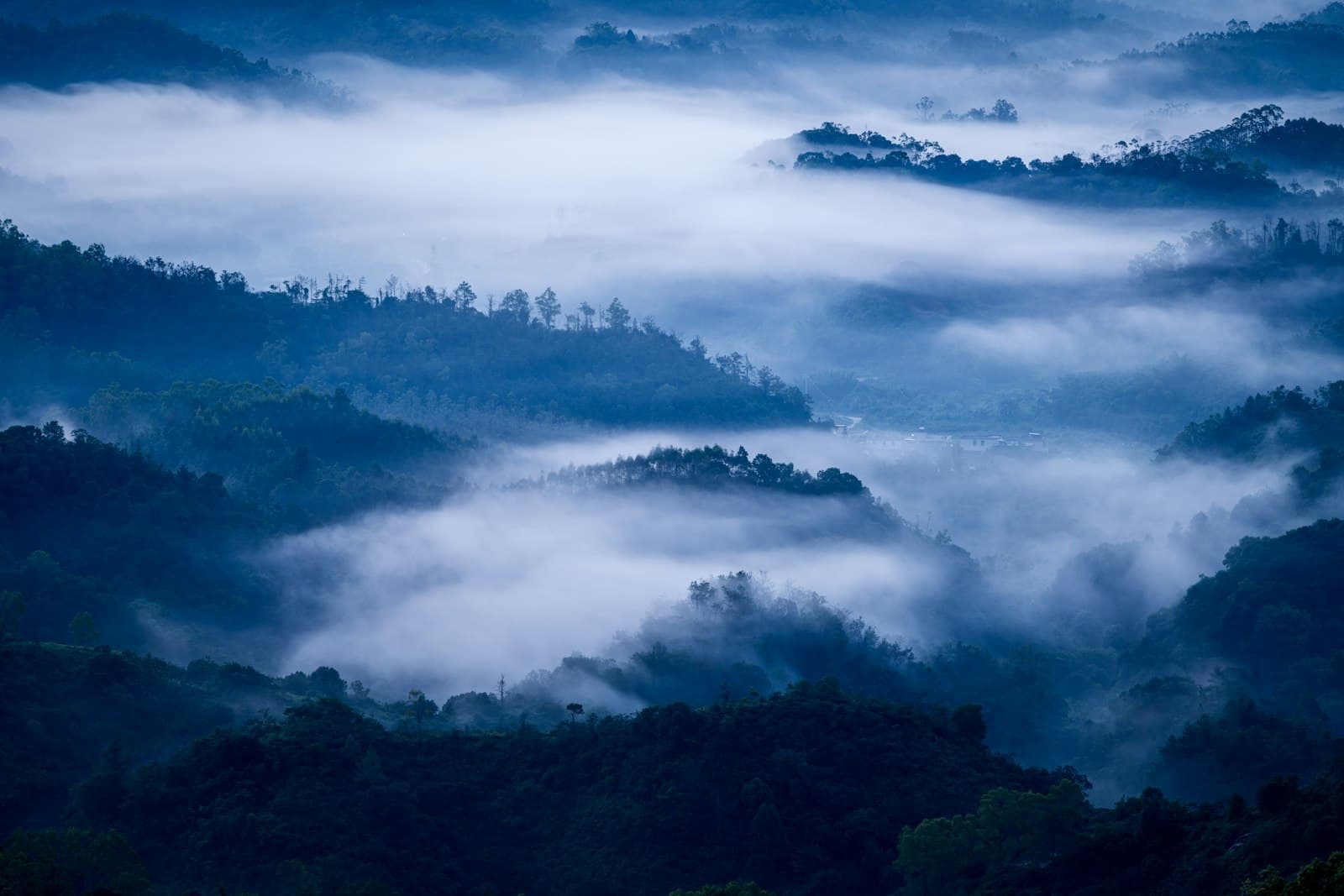
Above about 1,700m near the ridgelines it is too cold to grow well, and below 910m it isn’t recognized as “Blue Mountain.” Only the mountain’s narrow “sweet-spot zone” makes the king — and that narrowness is the source of its scarcity. A misty environment with large day-night swings ripens the cherries slowly, building a dense, clean cup.
Flavor profile — “the absence of flaws” as a character
Drink Blue Mountain for the first time and you may not feel “wow, so vivid!” That is to be expected: this bean’s true worth lies not in standout character but in “perfect balance,” with every element in equilibrium at a high level.
- Mild and smooth: a silk-like mouthfeel without edges
- Gentle acidity: not too bright, not too dull — refined and well composed
- Little bitterness or harshness: almost no unpleasant bitterness or astringency
- Faint sweetness and nuttiness: a gentle sweetness with nut and floral nuances
- A long, clean finish: refreshing and pleasant even after you finish
Blue Mountain is not a bean that “hits you with character” but one with “no gaps anywhere.” If you are used to flashy, fruity African coffees it can feel underwhelming — but you can drink it every day without tiring, and anyone calls it delicious. That universal completeness is why it is king.
Grades — No.1, Peaberry and Select
Blue Mountain is graded mainly by bean size (screen size) and the scarcity of defects. The top is No.1.
- No.1: the largest beans (screen 17/18) with the fewest defects — the top grade
- No.2: slightly smaller than No.1 (screen 16)
- No.3: smaller still (screen 15)
- Peaberry (PB): the round single bean from a cherry with just one seed. Said to be concentrated
- Select / Triage: lower lots gathering the off-grades
Coffee carried in barrels
While most green coffee moves in jute sacks, Blue Mountain is traditionally shipped in wooden barrels — rare among premium beans worldwide. This is said to be a holdover from British colonial times when goods were transported in barrels, and is now a symbol of the brand. There is a practical side — protecting the beans from moisture and shock — but above all, “barrel-packed = real Blue Mountain” has become a mark of trust.
A deep tie to Japan — most exports go to Japan
You cannot discuss Blue Mountain without its relationship with Japan. Historically, roughly 70–80% of the Blue Mountain that Jamaica produces has been exported to Japan. From the 1960s on, Japanese trading houses and coffee companies invested in growing and processing facilities and provided technical support, sustaining the industry as a stable buyer. During the bubble years it was a staple luxury gift and exploded in popularity — the image of “Blue Mountain = top-tier coffee” owes much to the Japanese market.
“Seeing Blue Mountain everywhere in Japan” is no coincidence. Because Japan remained the largest export destination for years, its distribution and name recognition are heavily rooted here. Conversely, in the Western specialty scene, opinions on its value relative to price can be divided.
Beware of fakes and blends
Because it is expensive and popular, this origin attracts a lot of misleading products. Be especially careful with the label “Blue Mountain Blend.” This can contain only a tiny amount of real Blue Mountain (sometimes a few percent) and is a different thing from pure Blue Mountain.
“Blue Mountain,” “Blue Mountain Blend” and “Blue Mountain style” are entirely different. Pure Blue Mountain states the origin and grade (No.1, etc.) and is certified by JACRA. Assume anything extremely cheap is a product with only a tiny blend, or from a different origin. For reading labels, see our roaster label article too.
Blue Mountain vs. Hawaii Kona — the two great mild luxury beans
Blue Mountain is often compared with Kona coffee from the island of Hawaii. Both share “a mild, balanced luxury bean,” a “resort brand” and a “high price.” As for differences, Blue Mountain tends toward a gentler, more refined harmony, while Kona leans to a slightly brighter acidity with nutty, caramel-like sweetness. Both are honor students valued for “drinkability” over “intense character” — and both make good gifts.
FAQ
What is the difference between Blue Mountain and Blue Mountain Blend?
“Blue Mountain” is a certified, pure single-origin bean. “Blue Mountain Blend” is a mixture containing only part (sometimes a tiny amount) of the real thing. The price and the contents differ greatly, so always check the origin and grade labeling and whether it is certified.
Why is it so expensive?
The reasons compound. The plots where it can grow are extremely narrow and yields are low; cultivation on steep mountain terraces is labor-intensive and mostly hand-picked; the logistics (barrel packing) are laborious; and global demand — especially in Japan — and brand value are high. Scarcity and popularity multiply to push the price up.
What roast and brewing method suit it?
To make the most of its balance and cleanliness, around a medium roast is recommended. Its hallmark is delicate harmony, so roasting it too dark buries its character. For brewing, hand drip that extracts cleanly without harshness is the royal road. With such a costly bean, brew it carefully — freshly ground, at the right temperature (around 90°C) — and savor that smoothness and finish.
The essence of Blue Mountain is “perfect balance,” the opposite of “ostentatious character.” There may be no flashy statement in the cup, yet you finish it and quietly think, “ah, that was good.” The king’s dignity was built by narrow highlands, strict management, and a long tie with Japan. When you choose a special cup, knowing the backstory makes the taste all the deeper.
Was this article helpful?
Origins in this article
Choose & compare
Related links
More articles
Taiwan Coffee Deep-Dive: The Tea-Like Cup Born of Alishan’s High Mountains
BeansThe Bourbon Variety — the Origin of Specialty
BeansHawaiian Kona Coffee: The Volcanic Slopes Behind a “Top-Three” Coffee, and the Story of Japanese Immigrants
BeansThe Science of Roasting — Why a Green Bean Turns Into That Aroma and Color, from the Maillard Reaction to Second Crack