Why Geisha Keeps Breaking the World Price Record
The "Romanée-Conti of coffee," born in Panama
Learning path · Advanced/Chapter 3
One of the 7 chapters in this level. Tap the button on the right when you finish reading to log your progress.
Geisha can top ¥30,000 per pound. Why does it climb so high? A run through the variety, its history and today's market, all at once.
Contents · 8
In the world of specialty coffee, not a day goes by without hearing the name "Geisha." It burst onto the scene at Panama's Best of Panama (BoP) auction in 2004, breaking the previous record price — and it has gone on to rewrite the record almost every year since.
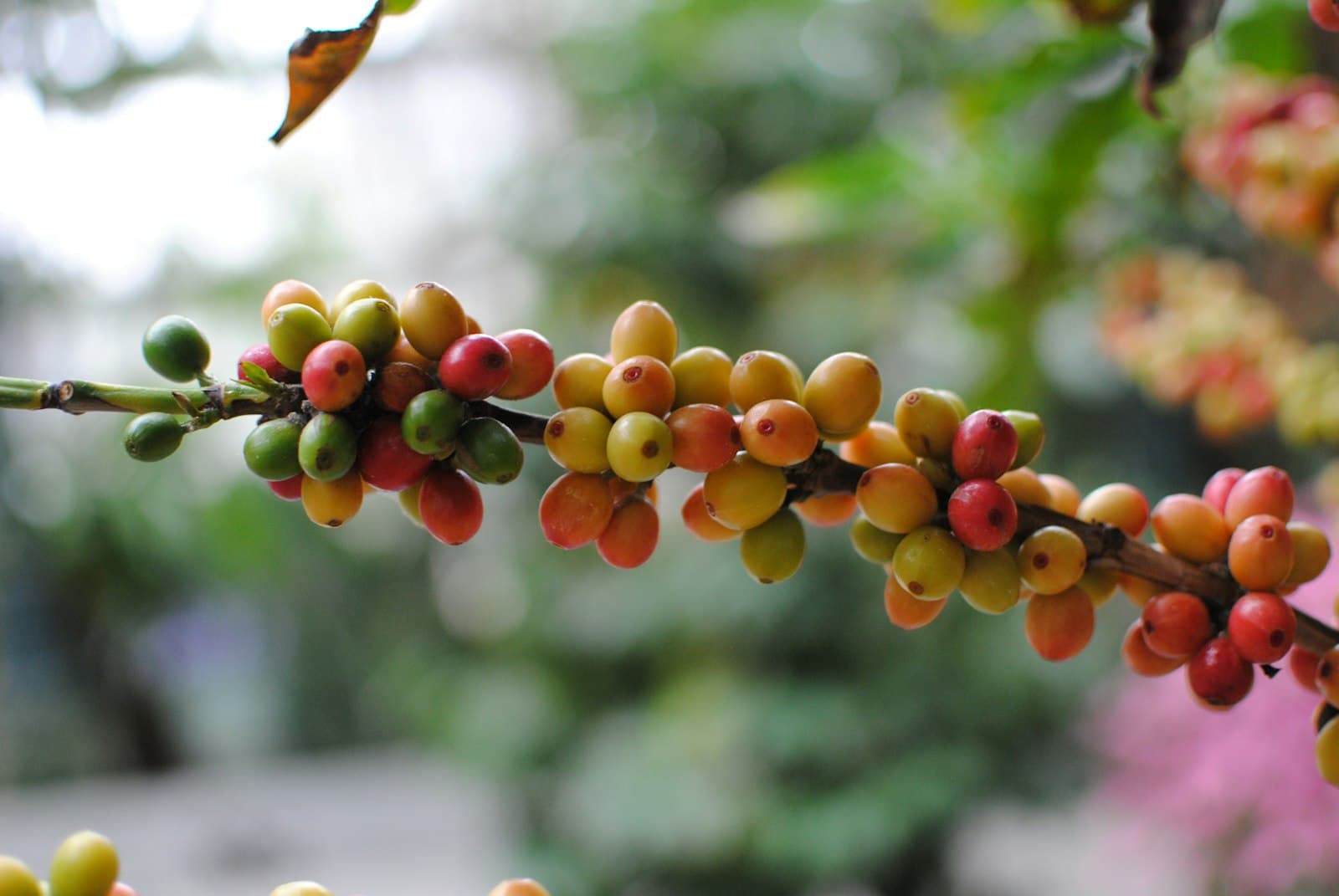
What is the Geisha variety?
Geisha (Gesha) is a landrace discovered in the 1930s in the village of Gesha in western Ethiopia. In 1953 it was brought to the CATIE research institute in Costa Rica, and from there it crossed to Panama. For a long time its low productivity meant no one gave it a second look — until beans grown by Hacienda La Esmeralda in specific plots above 1,600m turned out to produce a distinctive floral flavor of jasmine, bergamot and peach.
"Geisha" has nothing to do with the Japanese geisha. It is a wobble in the English transcription of the Ethiopian place name "Gesha." In fact the botanical records have it as "Gesha."
The price history
- 2004: $21.00/lb at BoP (the world record at the time)
- 2017: Hacienda La Esmeralda sells at $601/lb
- 2020: a natural-processed Geisha hits $1,300/lb
- 2023: the record tops $10,000/lb (a limited auction)
Why is it so expensive?
There are four reasons. First, the low productivity — you can harvest less than half of what a typical Arabica yields. Second, the demanding altitude — its true flavor only emerges in a specific microclimate above 1,600m. Third, the breadth of flavor it can show across processing methods such as washed, natural and anaerobic. And fourth, its brand value as the Romanée-Conti of the specialty world.
Major growing regions today
- Panama (Boquete and Volcán) — the original, the world's highest prices
- Colombia (Nariño, Huila) — mid- to upper-tier pricing
- Costa Rica (Tarrazú) — reliable quality
- Ethiopia (the west) — as a landrace / heirloom
Where can you drink it?
In Japan you may find it at third-wave shops such as Onibus Coffee in Nakameguro, Glitch Coffee in Kiyosumi-Shirakawa, and Weekenders Coffee in Kyoto. The going rate is ¥1,500–3,000 a cup. Bought by the 100g it ranges widely, from ¥6,000 to ¥30,000-plus, the top end edging into "collect it rather than drink it" territory.
Advice for your first cup
If you are drinking Geisha for the first time, the recommendation is paper drip, a light roast and water around 92°C. A French press or espresso will not make the most of this delicacy. To pull out the aroma to the full, let the grounds bloom for about 30 seconds before brewing.
Basic ratio for brewing Geisha (about 1:16, light roast)
Beans 14g / Water 230g
Washed vs natural: the same Geisha, a different drink
Geisha's expression changes greatly with the processing method. Even from the same farm, washed and natural are so different you might think "is this a different variety?" — so always check the processing on the label.
- Washed: the transparency of jasmine, bergamot and peach. The "textbook" floral Geisha. Start here if it is your first
- Natural: a dense sweetness of strawberry and tropical fruit. Fermentation-derived complexity rides on top; opinions divide
- Anaerobic: distinctive aromas like cinnamon and liqueur. Experimental, and hit-or-miss
If you want to know "what Geisha is" first, start with washed. That famous floral aroma rises most honestly from washed processing.
FAQ
Is it worth the price?
Honestly, "worth experiencing once." A jasmine-like aroma is hard to meet in other varieties, and it widens your idea of coffee. But it is a "special-occasion cup," not an everyday one. Start with one cup at a café, or an affordable entry lot.
Is cheap Geisha "fake"?
Not necessarily fake. Geisha from young trees or standard plots outside Panama's famous farms (Colombia, Costa Rica, Ethiopia and so on) is the real variety at a gentler price — ideal, in fact, for getting started.
Does it have to be from Panama?
No. Panama is the original and the pinnacle, but Colombia and Costa Rica also have excellent Geishas. With altitude above 1,600m, a light roast and washed processing in place, you can fully enjoy the variety's appeal wherever it is grown.
Why does Geisha smell so floral?
Aromatic compounds abundant in Geisha — terpenes such as linalool and geraniol — are the source of the jasmine- and bergamot-like aroma. This is a genetic trait inherited from the Ethiopian landrace, further concentrated as the cherries ripen slowly in the cool climate above 1,600m. Only when variety, altitude and processing line up in a trio does that floral aroma open to the full.
Why the different spellings, "Gesha" and "Geisha"?
Both refer to the same variety. Its origin is the place name "Gesha" in western Ethiopia, and botanically "Gesha" is the accurate spelling. Meanwhile, as it spread through Panama, the spelling "Geisha" took hold. It has nothing to do with the Japanese geisha — just a wobble in the English transcription of the place name. Lately, more roasters write "Gesha" out of respect for the origin.
Is drinking Geisha as espresso a waste?
Not quite "a waste," but a delicate washed Geisha shows its aroma better as a paper drip. Espresso, concentrating under high pressure, tends to bury Geisha's light floral character under other dense flavors. A natural-processed Geisha with dense fruit, on the other hand, holds its own even as espresso. The trick is to choose the brew method to match the processing.
Geisha is not "good because it is expensive" — it is a variety whose aroma only opens when the growing site, the plot and the processing all click into place. Start with a manageable cup and take a peek at coffee's ceiling.
Learning path · Advanced Chapter 3 — Up next
Chapter 4 · Espresso vs Drip Coffee: How Exactly They DifferWas this article helpful?
Origins in this article
Choose & compare
References
More articles
The Science of Coffee Aroma — The Story of the “800 Molecules” Rising From a Single Cup
BeansPanama Coffee Deep Dive — The Volcanic Highlands That Bore Geisha, and the Story of the World’s Highest Price
BeansThe Science of Bitterness — What Separates Unpleasant “Bitter” From Pleasant “Bitterness”
BeansCoffee and Climate Change — The “2050 Problem” and the Science of Our Cup’s Future