The Bourbon Variety — the Origin of Specialty
From the small island of Réunion to the world, the gene for sweetness
The foundation of Central and South American specialty almost all traces back to Bourbon. A sweetness-rich variety born on the small Indian Ocean island of Réunion (formerly Île Bourbon) and spread to Brazil, Central America and East Africa. Why is it called the origin of specialty?
Contents · 9
When talking about coffee varieties, the one that always appears alongside Typica is Bourbon. Open a high-quality Central or South American lot and much of it is Bourbon-derived. We unravel why this variety is called "the origin of specialty," from its roots and traits.
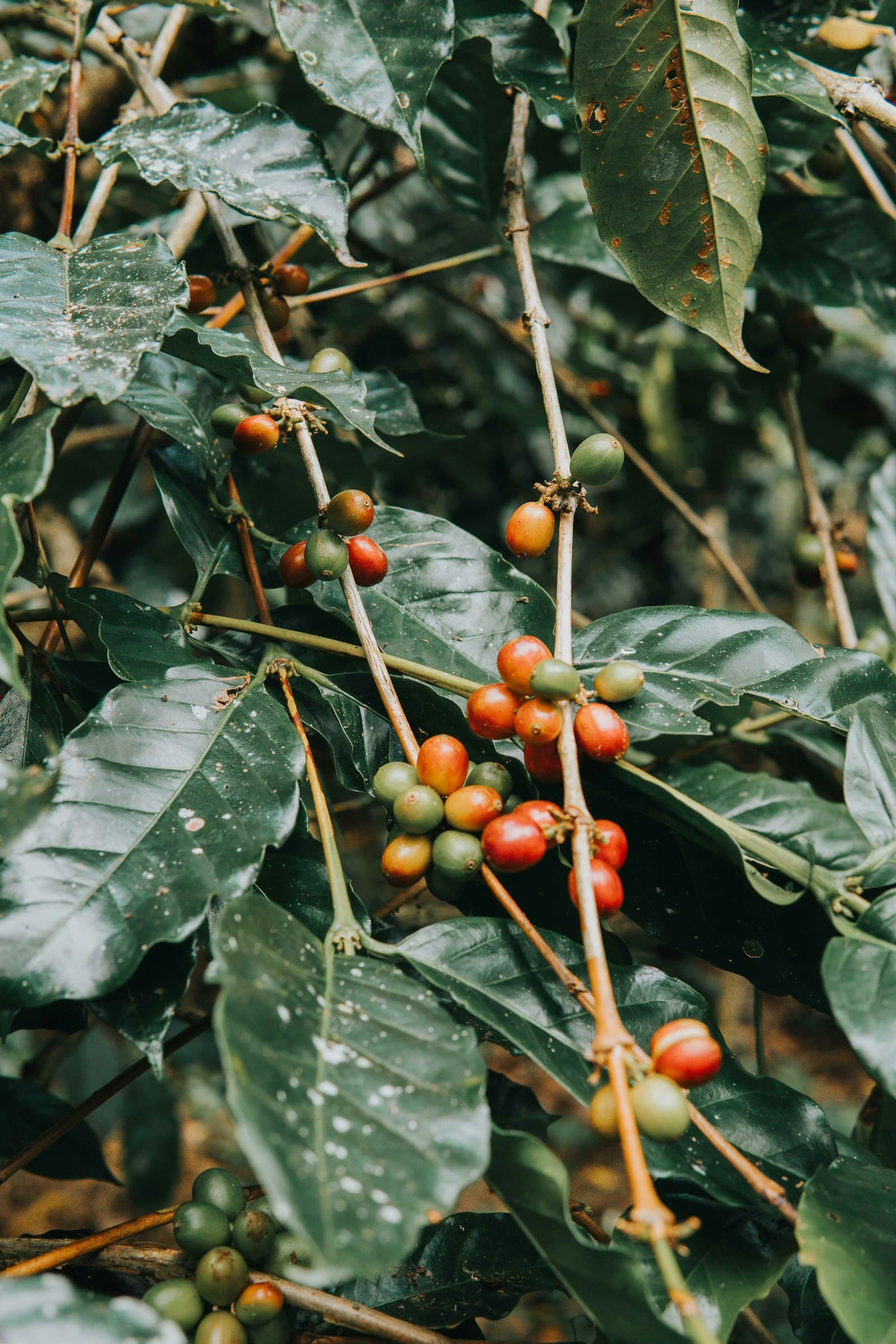
A small mutation that happened on an island
In the early 18th century, among coffee trees transplanted from Yemen to the French island of Réunion (then Île Bourbon), an individual appeared with round leaves and a different way of setting fruit. This was the beginning of Bourbon. As colonists spread it to Africa and South America, it took hold in the major producing regions around the world.
The difference from Typica
- Yield: Bourbon > Typica (about 20–30% more)
- Sweetness: Bourbon's is more complex, with nut, caramel and fruit coexisting
- Acidity: Typica's is round; Bourbon's is slightly brighter and juicier
- Tree shape: Bourbon is conical and compact; Typica is tall and narrow
A family born from mutations
Many further derivative varieties have arisen from Bourbon. Caturra (a dwarf mutation of Bourbon, found in Brazil), Catuai (Mundo Novo × Caturra), SL28 (a Tanzanian landrace of Bourbon lineage), and even some Geshas carry Bourbon blood. More than half of specialty varieties draw on Bourbon in some form.
What are Pink Bourbon and Yellow Bourbon?
Ordinary Bourbon bears red fruit, but mutants bearing yellow, orange and pink fruit have been selected. The color does not change the taste greatly, but Yellow Bourbon tends to have a stronger fruit sweetness, and Pink Bourbon is said to develop complex fermented aromas more readily.
Colombia's "Pink Bourbon" is handled at some farms in Nariño and parts of Huila, and has drawn attention as a COE-winning lot in recent years.
How to try Bourbon
El Salvador, the central highlands of Guatemala and Honduras, Brazil's Sul de Minas, and Rwanda and Burundi. "100% Bourbon" lots from these regions are relatively easy-to-obtain candidates. Choosing ones grown in the 1,400–1,800m altitude band brings out the variety's traits most readily.
How to spot Bourbon on the label
Often the bag does not say "Bourbon" in large letters, so the trick is to read it from the variety field and the origin context. If you see the signs below, it is likely Bourbon or one of its family.
- The variety field lists "Bourbon / Red Bourbon / Yellow (Amarelo) / Pink"
- A Caturra, Catuai or Mundo Novo label (all part of the Bourbon family)
- The origin is Central America (El Salvador, Guatemala), Brazil's Sul de Minas, or Rwanda and Burundi
- Tasting notes of "caramel, nut, red fruit, round acidity" — the classic phrasing for Bourbon character
Brewing to bring out Bourbon's character
Bourbon's strengths are a round, not-too-bright acidity, a caramel-like sweetness and a substantial body. Centering on a medium roast and brewing at 90–92°C in balance puts the most sweetness and depth in the cup. Too light and you get greenness; too dark and the delicate sweetness disappears — the middle road is the way.
Basic ratio for a V60 (1:16)
Beans 15g / Water 240g
How Bourbon's character changes by origin
Even the same Bourbon wears a different expression depending on where it grows. Differences in altitude, climate and processing all bear on the quality of the sweetness and how the acidity shows. Taste them side by side and you can see each origin's character riding on top of "the shared Bourbon frame." Use this as a guide when picking your first bag.
- El Salvador: textbook Bourbon. Caramel and nut with a mellow acidity. Ideal as an introduction
- Guatemalan highlands: chocolate sweetness with a firm body. Volcanic soil gives deep richness
- Brazil, Sul de Minas: nut and bitterness, lower acidity. Also a base for blends
- Rwanda and Burundi: highland-grown, bright and juicy. Red fruit and orange acidity show
- Yellow / Pink Bourbon: mutants. Sweetness and complex fermentation-derived aromas stand out
FAQ
Bourbon or Typica — which should a beginner start with?
Bourbon, whose sweetness and depth are easy to read, is the easier way in. Typica has a more delicate, refined acidity. Taste both at a medium roast and you can feel the difference in "how the sweetness shows," not just tree shape and yield.
Is Pink Bourbon expensive?
Popular in recent years and a frequent COE winner, it tends to cost more than ordinary Bourbon. Its complex fermented aromas and floral character are the draw, but build your "baseline Bourbon taste" with a standard red Bourbon first and the difference is more enjoyable. Pink Bourbon is a rare type that ripens between red and yellow, well regarded in the highlands of Colombia and Ecuador, and tends to show tropical-fruit and floral aromatics.
Are Caturra and Catuai also Bourbon?
Their variety names differ, but each was born from a Bourbon mutation or cross — the "Bourbon family." They inherit the sweetness tendency, and much of Central and South American specialty descends from this line.
What varieties are in the Typica line?
Typica branches into famous names like Jamaica's Blue Mountain, Hawaii's Kona, and Geisha. If Bourbon represents "sweetness and depth," the Typica line represents "clear delicacy and a refined acidity." Get these two great lineages down and you hold the center of the map for understanding varieties the world over. Typica yields little and is disease-prone, yet is still rated in a class of its own for cup refinement.
If you want to know specialty's "baseline for sweetness," Bourbon is the best starting point. Drink one through at a medium roast and it becomes your axis of comparison for every other variety. Next, line it up with Typica or Geisha and sketch the outline of your own preference.
Was this article helpful?
Origins in this article
Choose & compare
More articles
The Science of Coffee Aroma — The Story of the “800 Molecules” Rising From a Single Cup
BeansPanama Coffee Deep Dive — The Volcanic Highlands That Bore Geisha, and the Story of the World’s Highest Price
BeansThe Science of Bitterness — What Separates Unpleasant “Bitter” From Pleasant “Bitterness”
BeansCoffee and Climate Change — The “2050 Problem” and the Science of Our Cup’s Future