A Cultural History of the Kissaten — From Ueno’s “Kahi Chakan” to the World’s “KISSATEN”
Japan’s first coffeehouse, Ginza strolls and Café Paulista, a golden age of 150,000 shops, the craft culture of nel drip and dark roast, and the pure-kissaten revival — 138 years of coffee
It has been 138 years since Japan’s first coffeehouse, “Kahi Chakan,” opened in Ueno in 1888. The Ginza cafés, the classical-music and jazz kissaten, a golden age that topped 150,000 shops, the craft culture of nel drip and dark roast — the kissaten is where Japan grew a coffee culture unlike anywhere else. Today that culture influences specialty coffee worldwide as “KISSATEN,” while at home it is being rediscovered in a pure-kissaten (junkissa) boom. We trace 138 years of the Japanese coffeehouse, from the very beginning to now.
Contents · 11
- What is the difference between a “kissaten” and a “café”?
- 1888, Ueno’s “Kahi Chakan” — Japan’s first coffeehouse
- The Ginza café era — Paulista and the “Gin-bura”
- Music and coffee — from meikyoku kissa to jazz kissa
- War, ersatz coffee, and the 1950 reopening
- The age of the artisan — the aesthetics of nel, siphon and dark roast
- 1981, 150,000 shops — the kissaten’s peak and long twilight
- The food culture the kissaten created — morning sets, napolitan, cream soda
- The world discovered “KISSATEN”
- How to enjoy a junkissa — tips for first-timers
- FAQ
Push the heavy door and a bell chimes. An amber-polished counter, velvet chairs, the blue flame of a siphon. The air of a shop called a “junkissa” feels somehow nostalgic even on a first visit. The Japanese kissaten is not merely a place to drink coffee. In the 138 years since Japan’s first coffeehouse opened in 1888, this country has grown, inside these spaces, a coffee culture found nowhere else. And now that culture appears in overseas coffee media under the romanized word “KISSATEN,” rediscovered as one of the headwaters of specialty coffee worldwide. This article traces the history behind the cup, from the beginning to the present.
What is the difference between a “kissaten” and a “café”?
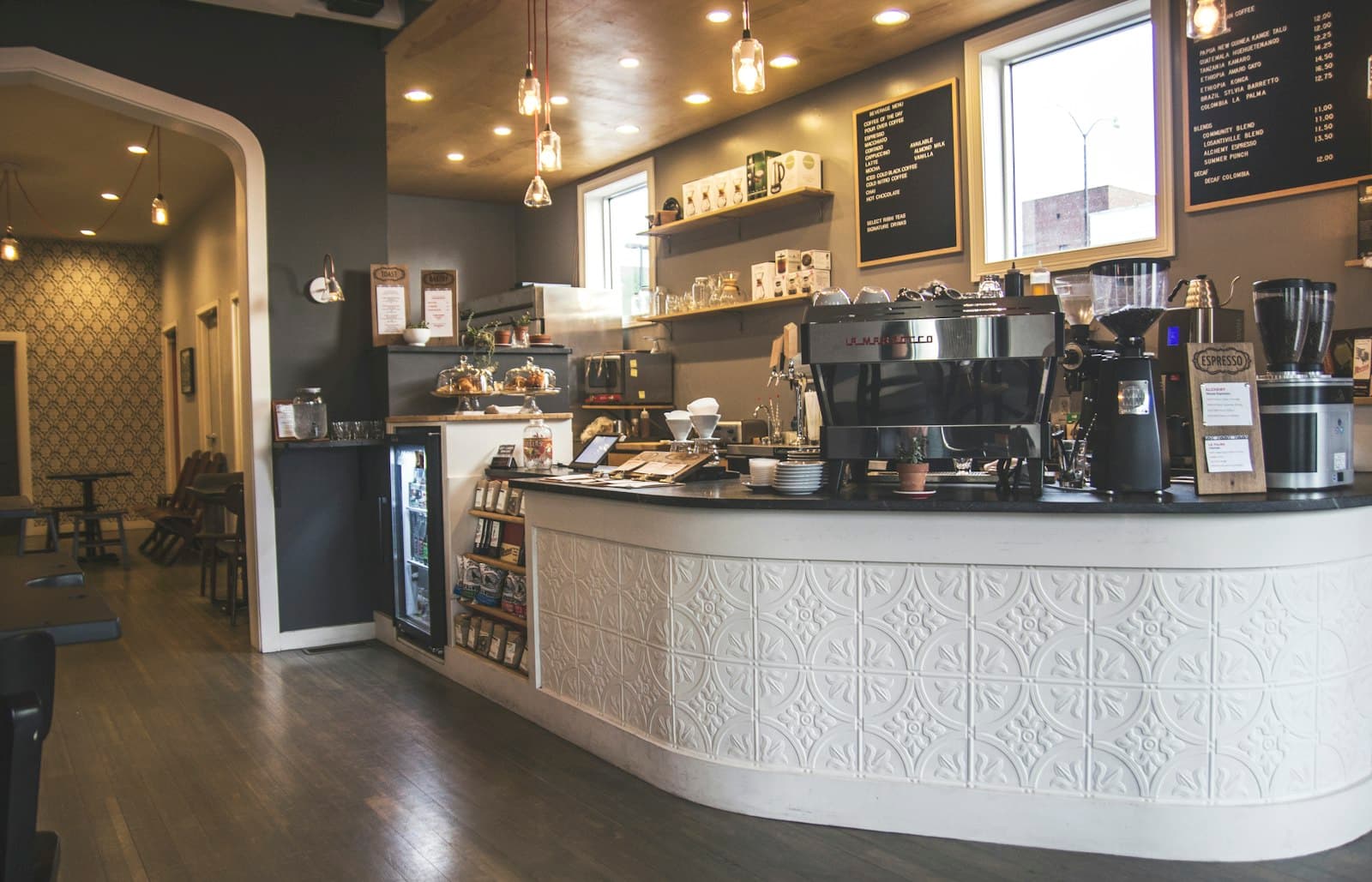
Start with the naive question: how does a “kissaten” differ from a “café”? For a long time there was in fact a clear legal distinction. Under the old Food Sanitation Act, two separate licenses existed — a “kissaten license” for shops that served no alcohol and did only limited cooking, and a broader “restaurant license.” But a revision to the Act that took effect in June 2021 merged the kissaten license into the restaurant license, and the legal distinction vanished. Today the difference between a “kissaten” and a “café” is better described as one of culture and aesthetics, not licensing.
- Kissaten: Shōwa-era interiors, a single cup brewed by the master, a fixed regulars’ culture. Dark roast and hand drip dominate
- Café: a name that spread from the 2000s on. Espresso machines, bright interiors, fuller food menus
- Junkissa (“pure kissaten”): a historical name coined to distinguish these shops from the alcohol-serving “kafē” (below). It means “a shop that purely serves coffee”
- Legally, all are now the same “restaurant business.” What distinguishes them is the air of the shop and our own mood
The “jun” (pure) in junkissa refers not to the purity of the coffee but to the purity of the business. In the Taishō–early Shōwa era, as “kafē” that served alcohol with female-server hospitality turned into pleasure-quarter establishments, shops that offered neither hospitality nor alcohol — purely serving tea and coffee — called themselves “junkissa.” That junkissa is now a byword for retro is proof that this word has survived intact from the Shōwa era.
1888, Ueno’s “Kahi Chakan” — Japan’s first coffeehouse
Japan’s first proper coffeehouse is considered to be “Kahi Chakan,” which opened in Ueno (Shitaya Kuromon-chō), Tokyo, in April 1888. It was opened by Tei Eikei, born into the family of a Foreign Ministry official and an intellectual who had returned from studying in America. His aim was not simply a shop that served coffee but a “cultural salon” where ordinary people could read newspapers and books, play billiards and cards, and exchange knowledge — an ambitious attempt to transplant to Meiji-era Tokyo the social function of the London coffeehouse and the Parisian café.
Coffee was 1 sen 5 rin a cup, 2 sen with milk. Since a bowl of kake-soba was around 1 sen at the time, that was 1.5 times the price of soba — in today’s feel, an 700–800 yen drink, hardly cheap. Perhaps too early for its era, the business struggled, and Kahi Chakan closed after only about four years. Tei Eikei sailed for America hoping to start again, and died in that foreign land. A commercial failure — yet the very idea of a “public space for drinking coffee” became the origin point of every kissaten that would later flourish in Japan.
“Kahi” (可否) is one of the phonetic character-spellings for “coffee.” Others — 珈琲, 加非, 哥非乙 — were tried in the Meiji era. The now-standard 珈琲 is said to be built from the character for a jeweled hairpin ornament (珈) and the cord that strings the hairpin’s beads (琲) — a picture of red coffee cherries strung along a branch.
The Ginza café era — Paulista and the “Gin-bura”
Kissaten culture began moving in earnest in the Ginza of 1911. That year the Western-style painter Shōzō Matsuyama opened “Café Printemps,” a salon for cultural figures, followed by “Café Lion.” And in the same year, one of the most important shops in Japanese coffee history — “Café Paulista” — was born in Ginza. Its founder, Ryō Mizuno, had been involved in Brazilian emigration schemes; using coffee beans supplied free by the São Paulo state government, he served proper coffee at an affordable 5 sen a cup. Young cultural figures such as Ryūnosuke Akutagawa frequented it, and it is even said that “strolling Ginza and drinking Brazilian coffee at Paulista” is the origin of “Gin-bura” — so thoroughly did Paulista become part of the Ginza scene (there are several theories of the word’s origin; the leading one is simply “to stroll Ginza”).
But from the Taishō into the Shōwa era, the “kafē” gradually changed character. They became bars with hospitality from women called jokyū, shifting into a pleasure-quarter trade. In response, shops that hung out a sign reading “ours offers neither hospitality nor alcohol; we purely serve coffee” were the “junkissa.” The junkissa, in other words, was a declaration of returning to coffee itself. Early-Shōwa Tokyo was packed with more than ten thousand kissaten and kafē, and they became the center of a modern urban culture of modern boys and modern girls.
Music and coffee — from meikyoku kissa to jazz kissa
The uniqueness of Japanese kissaten culture also shows in its invention of the “coffeehouse for listening to music.” In an era when records and gramophones were luxuries out of reach, the kissaten was a common people’s concert hall where, for the price of a cup, you could bathe in the latest music. The classical-music kissaten “Lion,” opened on Dōgenzaka in Shibuya in 1926, still upholds its style of playing classical records at high volume. In 1933 the pioneering jazz kissa “Chigusa” opened in Noge, Yokohama. After the war, jazz kissa reached their heyday, and “utagoe kissa,” where everyone sang together, became popular around Shinjuku.
- Meikyoku kissa: coffeehouses for appreciating classical records. A distinctive etiquette arose — refrain from chatter, immerse yourself in the music
- Jazz kissa: vast record collections and large speakers took the lead; the owner’s selection played the role of a medium
- Utagoe kissa: popular in the 1950s. A participatory space where all the customers sang along to accompaniment
- Manga kissa and game kissa: applied forms of the kissaten that kept absorbing each era’s entertainment — the ancestors of today’s manga cafés and net cafés
War, ersatz coffee, and the 1950 reopening
Shōwa kissaten culture was cut off once by the war. From around 1938 coffee imports were restricted, and by the war’s end they had ceased. Kissaten kept the memory of the aroma alive with “ersatz coffee” roasted from soybeans, acorns and dandelion roots. The turning points were the resumption of imports in 1950 and the liberalization of imports in 1960. From here the kissaten staged an explosive revival. Emblematic is “Café de l’Ambre,” opened in Ginza in 1948, ahead of the import resumption. Hanging out the sign “a shop of coffee only,” its founder Ichirō Sekiguchi remained an active roaster until his death at age 103 in 2018. A cup of aged green beans (old beans) brewed by nel drip can still be tasted in Ginza today.
The age of the artisan — the aesthetics of nel, siphon and dark roast
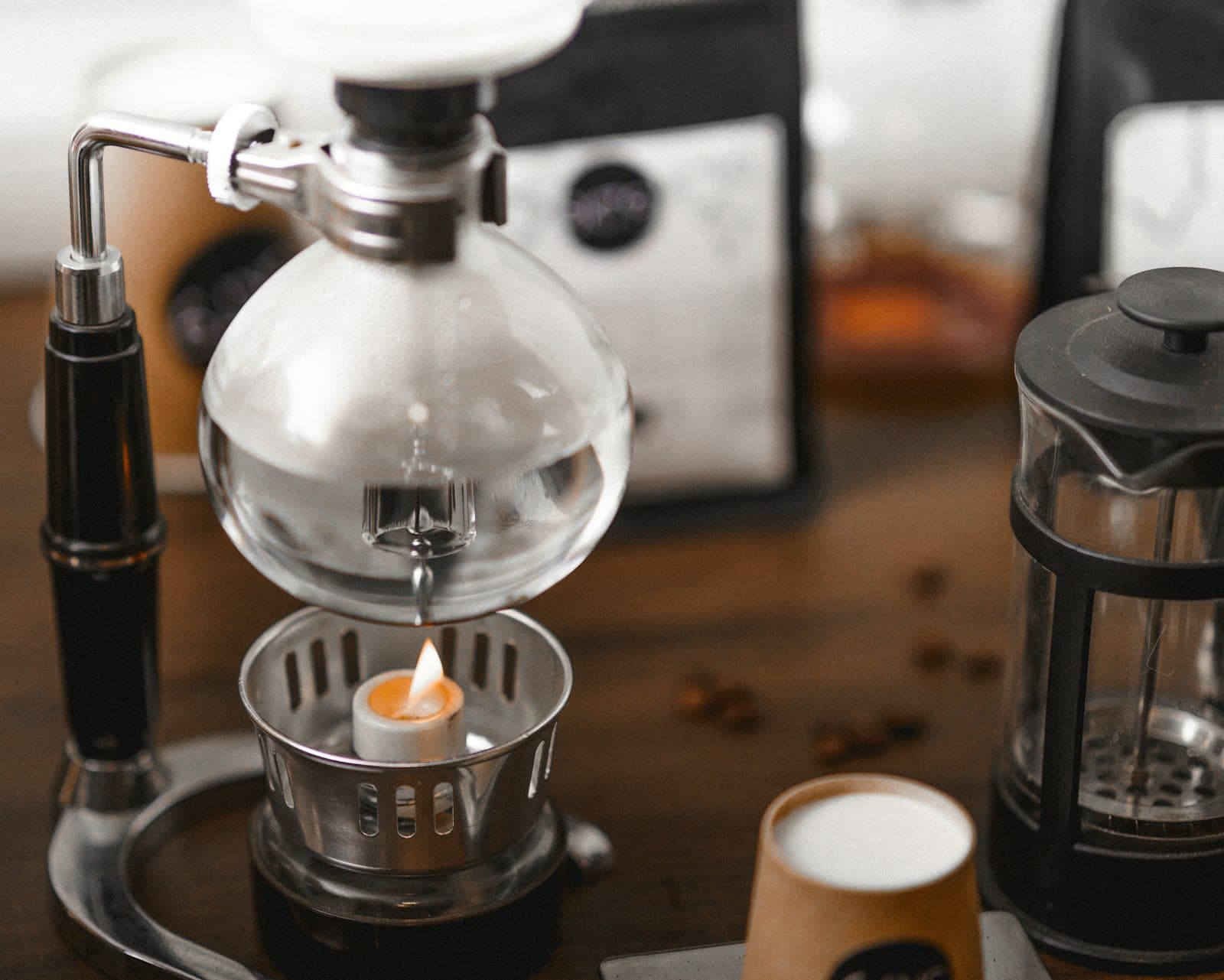
The greatest legacy the postwar kissaten nurtured is a craft culture of “brewing a single cup with care.” In an age when coffee was becoming a mass-produced, mass-consumed drink in much of the world, the Japanese kissaten chose the opposite road. The master weighs out one cup at a time of a dark-roasted bean he has roasted himself, and extracts it slowly by nel drip or siphon. The customer watches the gestures across the counter and waits quietly. “Daibō Coffee,” opened in Minami-Aoyama in 1975, upheld for 38 years a style of drip-by-drip nel brewing with beans roasted on a hand-cranked roaster, and when it closed in 2013 it was mourned even by coffee people abroad.
Why dark roast and nel? For one, in an era when adding sugar and milk was the norm, a richness that could stand up to them was demanded. For another, a slow, unhurried extraction matched the sense of time of a kissaten where you “sit and relax.” A dark-roasted cup with sweetness behind the bitterness was the culmination of a Japanese aesthetic that designs roast level and extraction as a set. This “focus on a single cup” is the very core of the Japanese coffee that would later astonish the world.
If you want to know the true nature of the kissaten’s “signature taste,” see our Complete Guide to Nel Drip. It explains the science of the thick, velvety mouthfeel the cloth filter brings, and how to reproduce it at home.
1981, 150,000 shops — the kissaten’s peak and long twilight
Riding the wave of high economic growth, kissaten kept increasing. The 1970s brought a boom in people quitting salaried jobs to open shops, and in an era of cramped housing they were used as a “substitute drawing room” — for business talks, for arranged-marriage meetings, for rendezvous. The statistical peak was 1981. Kissaten nationwide reached roughly 154,000 — nearly three times the number of convenience stores today (about 57,000) — standing in front of stations and along shopping streets all across Japan.
The following 40 years were a long decline. Doutor Coffee, which opened its first shop in Harajuku in 1980, changed the relationship between time and coffee with “stand-and-drink for 150 yen,” and in 1996 Starbucks landed its first store outside North America in Ginza. Following UCC, which in 1969 released what is known as the world’s first canned coffee with milk, and Pokka, which in 1973 put hot-and-cold vending machines into practical use, Seven Café realized “freshly brewed for 100 yen” in 2013. Individually run kissaten could no longer compete on price or speed, and with aging owners and a shortage of successors compounding matters, by 2021 the number had fallen to about 59,000.
The food culture the kissaten created — morning sets, napolitan, cream soda
The kissaten also created its own food culture. The prime example is “morning” — a service where ordering coffee in the morning hours comes with toast and a boiled egg. It is said to have begun when textile makers in Ichinomiya, Aichi, held business talks in kissaten to escape their noisy factories (there is also a Toyohashi-origin theory). In the Nagoya region it still evolves as a culture where “breakfast is covered by the price of a coffee,” and even produced a masterpiece in ogura toast. Kissaten menus line up with such “Western dishes that evolved uniquely in Japan.”
- Morning: a kissaten breakfast service said to originate in Aichi. In the Nagoya region it grew lavish and became a tourist draw
- Napolitan: said to originate at a Yokohama hotel, but it was the griddles and ketchup of kissaten nationwide that raised it into a national dish
- Pizza toast: said to have begun around 1964 when the Yūrakuchō kissaten “Benishica” reproduced then-expensive pizza on sliced bread
- Coffee jelly: sold by Mikado Coffee in 1963 as “coffee you eat,” it became a kissaten standard
- Wiener coffee: there is no drink by that name in Vienna; the style of floating whipped cream took root in Japanese kissaten as a homegrown menu item
- Cream soda: rooted in the Meiji-era soda-water culture. Green soda with a scoop of ice cream became a symbol of the junkissa boom
The world discovered “KISSATEN”
In the 2000s, a coffee movement called the “third wave” arose on the U.S. West Coast. Facing the origin and individuality of the bean, brewing cup by cup by hand — that was, in fact, what the Japanese kissaten had been doing for half a century. James Freeman, founder of Blue Bottle Coffee, openly professed his love for Japanese kissaten culture, and in 2015 chose Kiyosumi-Shirakawa as the site of his first overseas store. The very style of hand drip, Japanese brewing tools such as Hario and Kalita, and the word “kissaten” have now become the shared vocabulary of specialty coffee worldwide. The three waves of coffee history rolled in, in Japan, in a distinctive order.
Reappraisal is advancing at home, too. From the late 2010s a “junkissa boom” arrived, as younger generations sought retro interiors and cream soda. Amber-toned spaces flooded social media, lines formed at long-established shops that had nearly closed, and more young owners opened new shops in the Shōwa style. The statistical shop count keeps falling, yet demand for “the kissaten-like” seems, if anything, to be growing stronger.
How to enjoy a junkissa — tips for first-timers
- Start with the blend: the shop’s signature is its “blend,” designed by the master — the face of the shop, where the dark-roast kissaten character shows most
- Enjoy the fixed menu: pudding, napolitan, pizza toast, cream soda. Savor kissaten Western food as a whole aesthetic
- Lingering is the culture: the kissaten is not a turnover business but a place-to-be business. Bring a book and take your time
- Try sitting at the counter: the gestures of nel and siphon are best seen from the front-row seat. Many masters are glad to teach if you ask
- Aim for the morning: “morning” is the strongest entry point into kissaten culture, and the regional differences are fun
If you don’t know which shop to visit, look for these markers: a shop with a long history, one that advertises in-house roasting, and one where siphon or nel equipment is visible on the counter. After that, all you need is the courage to push the door. Junkissa that turn away newcomers are, in fact, almost nonexistent.
FAQ
What is the difference between a kissaten and a café?
Formerly the Food Sanitation Act separated a “kissaten license” (no alcohol, no full cooking) from a “restaurant license,” and this served as a rough line. A 2021 revision merged the licenses, so there is now no legal distinction. As a present-day feeling, it is a cultural difference: shops with dark roast, hand drip, Shōwa interiors and a master culture tend to be called “kissaten,” while shops with espresso machines and bright interiors are called “cafés.”
What does junkissa (“pure kissaten”) mean?
It is a name that shops offering “purely tea and coffee” adopted in the Taishō–early Shōwa era to distinguish themselves from the alcohol-serving “kafē” with their female-server hospitality. Originally, in other words, it was a “declaration of wholesome business.” Today it has settled in as a word for retro kissaten that uphold Shōwa interiors and standard menus, and it is at the center of a boom among younger generations.
What was Japan’s first coffeehouse?
“Kahi Chakan,” which opened in Ueno, Tokyo, in 1888, is considered Japan’s first proper coffeehouse. Its founder was Tei Eikei, an intellectual who had returned from America. Selling coffee at 1 sen 5 rin a cup, it aimed to be a cultural salon equipped with books and billiards, but closed after about four years. As for the oldest surviving kissaten, Ginza’s “Café Paulista,” founded in 1911, is still in business.
Why did “morning” develop in Aichi?
The leading theory is that it originated in Ichinomiya. In Ichinomiya, where the textile industry thrived, there was a custom of holding business talks in kissaten to escape the noise of the looms, and the prototype is said to be shops adding peanuts and boiled eggs as a service for regulars (there is also a Toyohashi-origin theory). Competition among kissaten made the offerings lavish, and it took root as the breakfast culture of the whole Nagoya region.
Is wiener coffee really a Viennese drink?
There is no drink called “wiener coffee” in Vienna. The closest is the “einspänner,” topped with whipped cream, but the style and name that took root in Japanese kissaten are uniquely Japanese. Like napolitan, it is a prime example of “kissaten Western food” — borrowing a foreign name while evolving uniquely in Japan.
Is the number of kissaten still falling?
Statistically the decline continues. From about 154,000 kissaten at the 1981 peak, the count fell to roughly 59,000 by 2021. The main causes are aging owners and a shortage of successors, plus competition from chain stores and convenience-store coffee. On the other hand, the junkissa boom since the late 2010s has advanced a reappraisal of long-established shops, and young owners are opening new shops in the Shōwa style — movements that make it hard to call this a simple decline.
The 138 years of the kissaten are a history of Japan continuously translating coffee — a foreign drink — into its own culture. It began with the dream of a cultural salon, then Ginza modernism, a cathedral of music, the artisan’s cup, and the “KISSATEN” that crossed to the world. The next time you push the heavy door of a junkissa, remember, just a little, that behind that one cup lies 138 years of story.
Was this article helpful?
Origins in this article
Choose & compare
Related links
More articles
The Basics of Pairing Coffee and Food
CultureThe History of Coffee: From an Ethiopian Legend to the "Third Wave"
BeansThe Coffee Variety Family Tree — Reading the “Genealogy” That Begins with Typica and Bourbon
BeansThe Coffee Belt and Terroir — Why Coffee Grows Only in the “Equatorial Band,” and Why Each Origin Tastes Different