The Coffee Variety Family Tree — Reading the “Genealogy” That Begins with Typica and Bourbon
From arabica’s two great ancestors to Caturra, Geisha, SL, Pacamara and F1 hybrids — why variety decides taste and the future
On the shelf of specialty coffee sit words that are neither an origin nor a roast level: “Geisha,” “Bourbon,” “SL28,” “Pacamara.” These are all “varieties” — just as an apple has “Fuji” and a grape has “Chardonnay,” coffee too has varieties that serve as a blueprint for taste. And astonishingly, most of the arabica drunk around the world is descended from a “family tree” that branched from just two ancestors — Typica and Bourbon. This article traces the family tree of arabica varieties along three forces: mutation, crossbreeding, and the fight against disease. Knowing variety reveals a “third blueprint of taste” alongside terroir and roasting.
Contents · 10
- What a “variety” is — species, botanical variety and cultivar
- The ancestor of all — Typica and Bourbon
- Varieties born of mutation — Caturra and Maragogype
- Varieties born of crossbreeding — Mundo Novo, Catuai, Pacamara
- The fight against disease — robusta blood and the Timor Hybrid
- Geisha — the variety whose aroma changed the world
- SL28/SL34 and Ruiru 11 — Kenya’s fine varieties
- F1 hybrids — the front line of breeding
- How far does variety decide the taste?
- FAQ
On the shelf of specialty coffee sit words that are neither an origin nor a roast level: “Geisha,” “Bourbon,” “SL28,” “Pacamara.” These are all “varieties” — just as an apple has “Fuji” and “Jonathan,” and a grape has “Chardonnay” and “Pinot Noir,” coffee too has varieties that serve as a blueprint for taste. And astonishingly, most of the arabica drunk around the world is descended from a “family tree” that branched from just two ancestors — Typica and Bourbon. This article traces the family tree of arabica varieties along three forces: mutation, crossbreeding, and the fight against disease. Knowing variety reveals a “third blueprint of taste” alongside terroir and roasting.
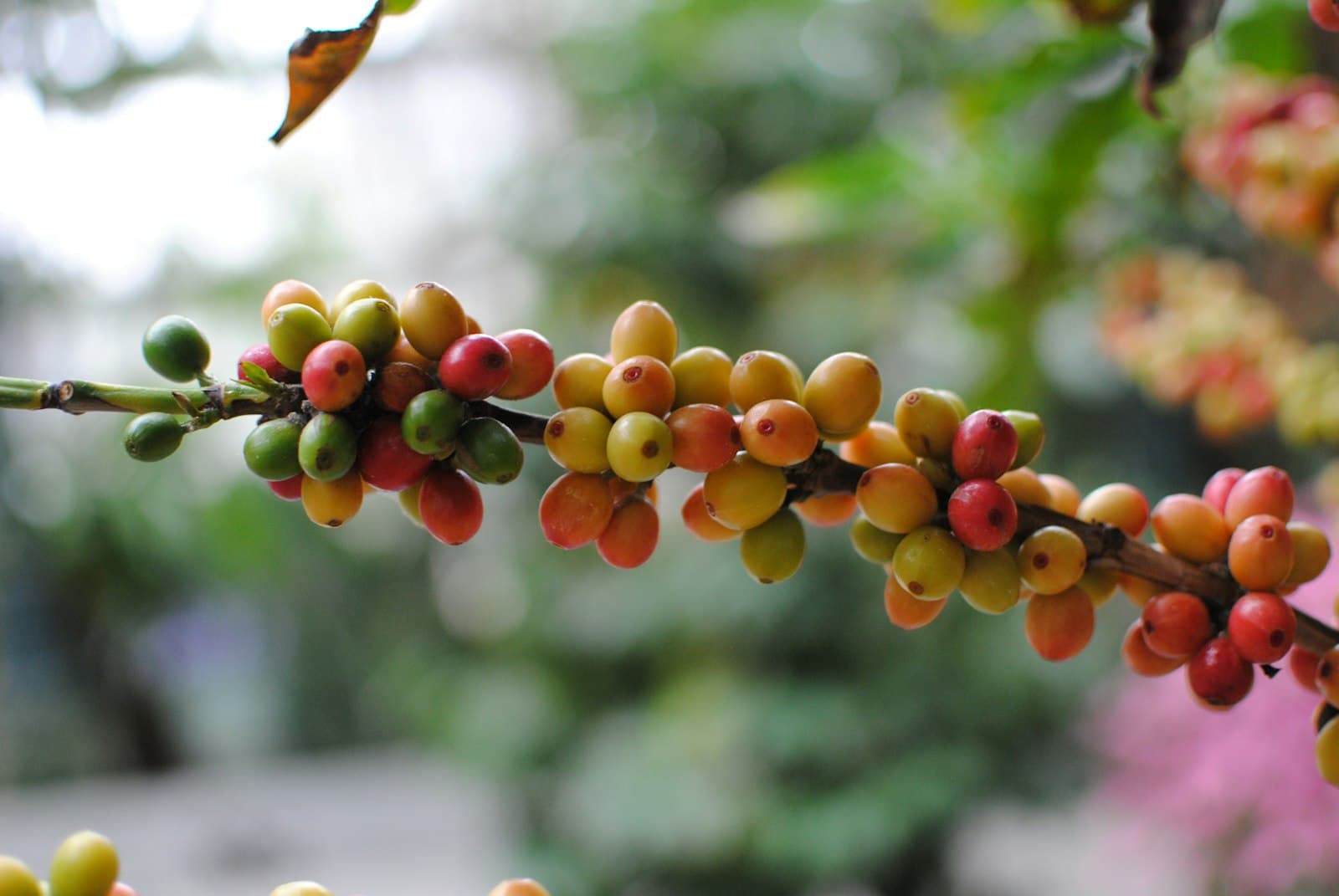
What a “variety” is — species, botanical variety and cultivar
Before we begin, let us sort out the words. In botany there is first a “species,” and within it “botanical varieties” and “cultivars” that people have selected and bred. For coffee, the representatives that are drunk are two species: “arabica (Coffea arabica)” and “canephora (= robusta, Coffea canephora).” What we call “Bourbon” and “Geisha” are varieties (botanical varieties and cultivars) within the arabica species. In other words, “arabica” is the name of the large species, and “Bourbon” is one lineage within it. In daily life they are called “varieties” without strict distinction, and this article too, following convention, calls the lineages within arabica “varieties” collectively. The difference between the species arabica and robusta themselves is covered in detail in arabica vs. robusta.
Arabica has a weakness at odds with its richness of taste: a poverty of genetic diversity. Arabica is a self-pollinating plant (it fruits with its own pollen), and tracing its origin, it passed through a “genetic bottleneck” — a very few seeds crossed from Ethiopia to Yemen, and from there spread to the world. In other words, cultivated arabica around the world is a set of genetically very close “relatives.” This uniformity is both the reason it is weak to diseases like leaf rust, and the backdrop against which breeding matters.
The ancestor of all — Typica and Bourbon
Trace back the family tree of arabica varieties and nearly all arrive at two classic varieties: “Typica” and “Bourbon.” Both are arabica that spread to the world from the homeland of Ethiopia by way of Yemen, but because the routes of transmission diverged, they became two lineages. Typica is the lineage that went from Yemen through India and Indonesia (Java), and in the 18th century crossed to Latin America by the hands of the Dutch and French. It is marked by long, slender beans and a delicate, clean sweetness. Bourbon is the lineage that crossed from Yemen to the French island of Bourbon (present-day Réunion) and changed there; its name too derives from this island. It has a higher yield than Typica, rounded beans, and is known for a sweeter, more complex flavor. These two became the “Adam and Eve” of the countless varieties that followed.
- Typica: one of the oldest cultivars. Long, slender beans, clean and delicate sweetness. Low yield and weak to disease, but highly rated for flavor. The foundation variety of Blue Mountain and Kona
- Bourbon: a classic variety that split from Typica. Round beans, rich sweetness and complexity. Higher yield than Typica, with red, yellow and pink fruit-color mutations. The cornerstone of Latin America’s fine coffees
Varieties born of mutation — Caturra and Maragogype
As they grow, plants occasionally undergo a natural “mutation.” A part of a branch alone changes in character, and if it is useful, people select and fix it into a new variety. The family tree of arabica has many varieties born from this mutation. The representative is “Caturra,” found in Brazil — a mutation in which Bourbon dwarfed (became short-statured); it is short, can be planted densely, and has high yield. Thanks to this it suits mechanization and intensive cultivation, and it spread explosively across Latin America. Likewise Bourbon-derived, “Yellow Bourbon” is a mutation whose fruit ripens yellow rather than red, and “Pacas” is a dwarf mutation found in Central America. From the Typica side came the “Maragogype (elephant bean)” mutation, in which the bean grew gigantic. Mutation brought coffee a new value: “agricultural usability.”
- Caturra: a dwarf mutation of Bourbon (Brazil). Short and high-yielding, suited to dense planting. Widely grown in Latin America
- Yellow Bourbon: a Bourbon mutation whose fruit ripens yellow. Popular for its mellow, sweet flavor
- Pacas: a dwarf mutation of Bourbon found in El Salvador. Later becomes a parent of Pacamara
- Maragogype: a giant-growing mutation of Typica. Large beans called the “elephant bean.” Low yield but mellow
How Bourbon and its mutations became the foundation of Latin American specialty is explained in detail in the story of Bourbon. If you spot the words “Bourbon lineage” on a label, it is proof of a classic pedigree aiming at sweetness and complexity. That dwarf mutations rewrote the coffee map with the agricultural value of “high yield” is one of the pleasures of knowing variety.
Varieties born of crossbreeding — Mundo Novo, Catuai, Pacamara
Alongside mutation, another force is “crossbreeding.” Different varieties are artificially crossed to make a new variety that inherits the strengths of both. “Mundo Novo,” born in Brazil, arose from a natural cross of Typica and Bourbon; it is hardy and high-yielding, and remains one of Brazil’s mainstays. Crossing this “Mundo Novo” with the dwarf “Caturra” produced “Catuai” — short, strong against wind and rain, with types that ripen red or yellow. In El Salvador, crossing the dwarf “Pacas” with the giant “Maragogype” produced “Pacamara,” whose large beans and gorgeous character are prized, now a regular at competitions. Crossbreeding could be called the technique of “bundling and designing” the character mutation produced.
- Mundo Novo: a natural cross of Typica × Bourbon (Brazil). Hardy and high-yielding. A Brazilian mainstay
- Catuai: Mundo Novo × Caturra. Dwarf with high wind-and-rain resistance. There are red and yellow varieties
- Pacamara: Pacas × Maragogype (El Salvador). Large beans, gorgeous, with a distinctive complexity. A competition favorite
The fight against disease — robusta blood and the Timor Hybrid
The history of arabica varieties is also a history of the fight against disease — above all “leaf rust (a contagious disease that withers coffee leaves).” Genetically uniform arabica is weak to leaf rust, and in the 19th century the coffee industry of Ceylon (present-day Sri Lanka) was wiped out by it, to the point of converting into a nation of tea. The key that saved this crisis was found in an unexpected place. The “Timor Hybrid (HdT)” discovered in East Timor — a rare individual in which arabica and robusta had naturally crossed — carried robusta-derived leaf-rust resistance. Crossing this HdT with dwarfs like Caturra produced the disease-resistant arabica variety groups “Catimor” and “Sarchimor.” But when robusta blood enters, the delicacy of the cup can be somewhat impaired in exchange for resistance, and “resistance or flavor” has become an eternal theme of breeding.
The destructive power of leaf rust is proven by history. The great leaf-rust epidemic that began in Ceylon in 1869 wiped out this island’s coffee industry, then one of the world’s foremost, and converted its estates to tea (that whole story is written in detail in the story of Sri Lanka = Ceylon). In recent years too it raged across Central America, and many farmers were dealt a blow. The development of disease-resistant varieties is still the front line of protecting producers’ livelihoods.
Geisha — the variety whose aroma changed the world
What showed the world the power of variety most dramatically is “Geisha (Gesha).” Originally a landrace deriving from around the village of Gesha in western Ethiopia, it had been distributed to various places for disease-resistance research. It went long unnoticed, but in 2004 the Hacienda La Esmeralda in Panama entered this variety in a competition and astonished the judges with an overwhelming aroma suggestive of jasmine, bergamot and tropical fruit. Since then Geisha has become a top-grade variety fetching dozens of times the usual price at auction, and origins around the world have taken up the challenge of growing it. Yet even the same Geisha will not open that aroma if the altitude and the land (terroir) do not suit it — it is also a symbol of the twin wheels of variety and land.
Why Geisha is so expensive and what aroma it holds — that story is introduced in detail in Geisha, the world’s most expensive coffee. A single variety name can rewrite an origin’s fate and the price of coffee — Geisha is its most vivid example.
SL28/SL34 and Ruiru 11 — Kenya’s fine varieties
“SL28” and “SL34,” often seen on Kenyan labels, cannot be left out in speaking of the family tree. “SL” is the initials of the variety group selected in the 1930s by Kenya’s “Scott Laboratories.” Among them SL28 carries Bourbon-lineage blood, is strong against drought, and with a rich, blackcurrant-like fruitiness and powerful acidity pushed the reputation of Kenyan coffee to the world’s highest rank. SL34 is likewise known for high quality. Meanwhile, as practical varieties strong against leaf rust and pests, Kenya has also developed the cross varieties “Ruiru 11” and “Batian,” pursuing a balance of resistance and quality. The pedigree of the fine variety SL28 is dug into in the SL28 variety as well.
- SL28: a Bourbon-lineage selection by Scott Laboratories. Drought tolerance and a deep, blackcurrant-like fruitiness. A symbol of Kenya
- SL34: a selection alongside SL28. High quality at altitude. Somewhat more body
- Ruiru 11: a cross variety emphasizing disease resistance. A practical variety excelling in yield and resistance
- Batian: the successor to Ruiru 11. A newer variety that improves cup quality while keeping resistance
F1 hybrids — the front line of breeding
The story of variety is not a thing of the past alone. At the front line now are “F1 hybrids” — the first filial generation of crossing genetically distant parents. Cross different lineages and the offspring can show vigor exceeding both parents (hybrid vigor / heterosis), letting you aim at high yield, disease resistance and high quality at once. F1 varieties such as “Centroamericano” and the seed-propagable “Starmaya” are anticipated as “next-generation varieties” that withstand climate change and disease while keeping cup quality. With selection using DNA markers and the designing of heat and disease resistance, coffee breeding is now accelerating toward its greatest challenge, global warming.
Behind the attention on F1 hybrids lies the climate change threatening the coffee belt. As suitable land shrinks and the threat of disease grows, new varieties equipped with heat and disease resistance are a key to protecting coffee’s future. Breeding is an answer not only to “deliciousness” but also to the question of “whether we can keep drinking coffee from here on.”
How far does variety decide the taste?
So, how far does variety decide the taste of a cup? The answer is that “it decides the ‘ceiling’ and ‘direction’ of the taste, but whether that is drawn out depends on the land and people.” Geisha’s potential to hold a jasmine aroma derives from the variety, but if the altitude is insufficient that aroma will not open. SL28’s deep fruitiness, too, reaches the cup only when terroir, processing and roasting all come together. In other words, variety is one sheet of the “blueprint of taste” alongside terroir, processing and roasting. Even with an excellent blueprint, if the land, processing, roasting or brewing slips anywhere, it is ruined; and conversely, when everything meshes, a cup only that variety can give is born. The variety name on a label is the first clue for reading the “potential” that bean holds.
- What variety decides: the ceiling of the “type” of aroma and acidity, the bean’s shape and size, and ease of growing such as disease resistance and yield
- What terroir decides: how far that potential opens (altitude, climate, soil)
- What processing decides: the direction of sweetness, body and fruitiness (washed / natural, etc.)
- What roasting and brewing decide: which element to make the lead in the end, how the taste is presented
FAQ
How do “variety” and “origin” differ?
Variety is “what genes the tree has,” and origin is “where it was grown.” Even the same Geisha (variety) tastes different in Panama, Ethiopia and Taiwan — that is the difference of origin (terroir). Conversely, even the same Panamanian coffee, Geisha and Catuai smell entirely different — that is the difference of variety. Variety is the “blueprint” of taste; origin is “how that blueprint is developed.” Only by knowing both does the reason for a cup’s taste come into three dimensions. The variety name and origin name are both on the label because these two together decide the taste.
Are arabica and robusta “varieties” too?
Strictly, it is a difference of “species,” not “variety.” The arabica species and the canephora species (robusta) are separate species as far apart as an apple and a pear, even differing in chromosome number. The varieties we call “Bourbon” and “Geisha” are all lineages “within” the single species arabica. Robusta has varieties too, but the “variety family tree” generally spoken of is an arabica story. The fundamental differences between arabica and robusta (taste, caffeine, suitable growing land) are explained in arabica vs. robusta.
Why is Geisha so expensive?
Both rarity and a far-and-away aroma are the reasons. Geisha has low yield and is hard to grow, and opening that gorgeous aroma requires high altitude and suitable land. Ever since Panama’s Hacienda La Esmeralda astonished the world at a competition in 2004, demand has exploded, and at auction it sometimes fetches record prices of hundreds to thousands of dollars a pound. On top of the power of the variety itself, the rarity that “that aroma comes only from special land” pushes the price up. For details, see the story of Geisha.
Is it true that disease-resistant varieties taste inferior?
There was once an era when it was said “disease-resistant variety = inferior cup quality.” Catimor and the like, carrying robusta blood, sometimes fell short of classic varieties in the delicacy of flavor in exchange for strength against leaf rust. But recent F1 hybrids (Centroamericano and so on) are achieving a balance of resistance and heat tolerance with cup quality, and this conventional wisdom is being overturned. As growing conditions grow harsher with climate change, developing “delicious and strong” varieties is the most important theme for coffee’s future.
How can I use the variety name on a label in tasting?
The variety name is a clue for predicting the “direction of aroma” that bean holds. For example, Geisha tends toward the gorgeousness of flowers and bergamot, SL28 toward a deep blackcurrant-like fruitiness, and the Bourbon lineage toward mellow sweetness and complexity. Of course the final taste changes with origin, processing and roasting, but knowing the variety name lets you break down the taste — “this aroma may be variety-derived” — and makes tasting far more interesting. First, drinking varieties side by side from the same origin lets you grasp each variety’s character clearly.
Is there any point in being conscious of variety at home?
There is. Especially in specialty coffee, the variety name is an important clue to taste. If you “want to try a gorgeous aroma unlike the usual,” go for Geisha or Ethiopian landraces; for “rich fruitiness,” Kenya’s SL28; for “well-balanced sweetness,” the Bourbon lineage — you can enjoy choosing by variety. Holding the axis of variety, not only origin and roast level, raises the resolution with which you reach your preferred cup. For how to find your own preference, see how to find your taste too.
Inside a single cup flows a family tree of several centuries, one that journeyed from the forests of Ethiopia to Yemen, Bourbon Island and Latin America. From the two ancestors Typica and Bourbon, mutation produced new forms, crossbreeding bundled the strengths, the fight against disease brought resistance, and a single bean like Geisha astonished the world. The next time you find a variety name on a label, imagine which branch of this grand family tree it sits on. Variety is the third blueprint of taste, alongside terroir and roasting. Once you can read that name, coffee gains many times the depth.
Was this article helpful?
Origins in this article
Choose & compare
Related links
More articles
The Coffee Belt and Terroir — Why Coffee Grows Only in the “Equatorial Band,” and Why Each Origin Tastes Different
BeansThe Science of Coffee Acidity — What Fruitiness Really Is, and How It Differs from “Sour”
BeansTaiwan Coffee Deep-Dive: The Tea-Like Cup Born of Alishan’s High Mountains
BeansSri Lanka Coffee Deep-Dive: Ceylon’s Lost Coffee, the Blight That Turned It Into a Tea Nation