Tanzania Coffee Deep Dive: Kilimanjaro’s Bright Acidity and the Home of “Peaberry”
Northern Kilimanjaro and southern Mbeya, the AA grade, the round peaberry, and one of Africa’s oldest cooperatives
Blackcurrant fruit and a bright, juicy acidity — long loved under the name “Kilimanjaro,” Tanzania is an East African heavyweight with a powerful character close to Kenya’s. Known too as a home of the round “peaberry” bean, it shows different faces in the northern Kilimanjaro foothills and the southern Mbeya highlands. We dissect the taste, sustained by one of Africa’s oldest cooperatives.
Contents · 9
Long loved in Japan under the name “Kilimanjaro,” Tanzania grows its coffee at the foot of Africa’s highest peak — and its appeal is blackcurrant fruit and a juicy acidity that bursts across the palate. It has a powerful character close to neighboring Kenya, but also a face all its own as a home of the round “peaberry” bean. Through two growing areas — the northern Kilimanjaro foothills and the southern Mbeya highlands — plus the AA grade and one of Africa’s oldest cooperatives, we dissect the backstory of that taste.
Why Tanzania is special
- The Kilimanjaro name: volcanic soil and high altitude at Africa’s tallest peak grow a bright, powerful coffee
- Home of the peaberry: it has marketed the round single-seed “peaberry” as a signature
- A Kenya-like character: blackcurrant and citrus fruit with bright acidity — a structured East African taste
- A cooperative tradition: the KNCU (founded 1925) is one of Africa’s oldest cooperatives, supporting smallholders
- Two faces, north and south: flavor tendencies differ between northern Kilimanjaro and southern Mbeya / Mbinga
Most Tanzanian coffee is grown by smallholders and washed-processed at local cooperatives and washing stations. Beans are graded by size, the largest being “AA.” And the round “peaberry (PB)” — only a few percent of the crop — has long been prized as Tanzania’s signature.
Flavor profile
The Tanzanian archetype is a clean style: bright, juicy acidity layered with blackcurrant, berry and citrus fruit. It is a structured taste close to neighboring Kenya, but it doesn’t jut out as far — a touch gentler and more drinkable. Southern lots tend to push chocolate and sweetness to the front.
- North (Kilimanjaro): blackcurrant, citrus and a wine-like bright acidity and fruit. Leans Kenya
- South (Mbeya, Mbinga): chocolate and brown-sugar sweetness, mellow and balanced
- Body: medium — neither too light nor too heavy, with a clean finish
- Overall: an East African star that combines “Kenya’s power” with drinkability
What is a “peaberry”?
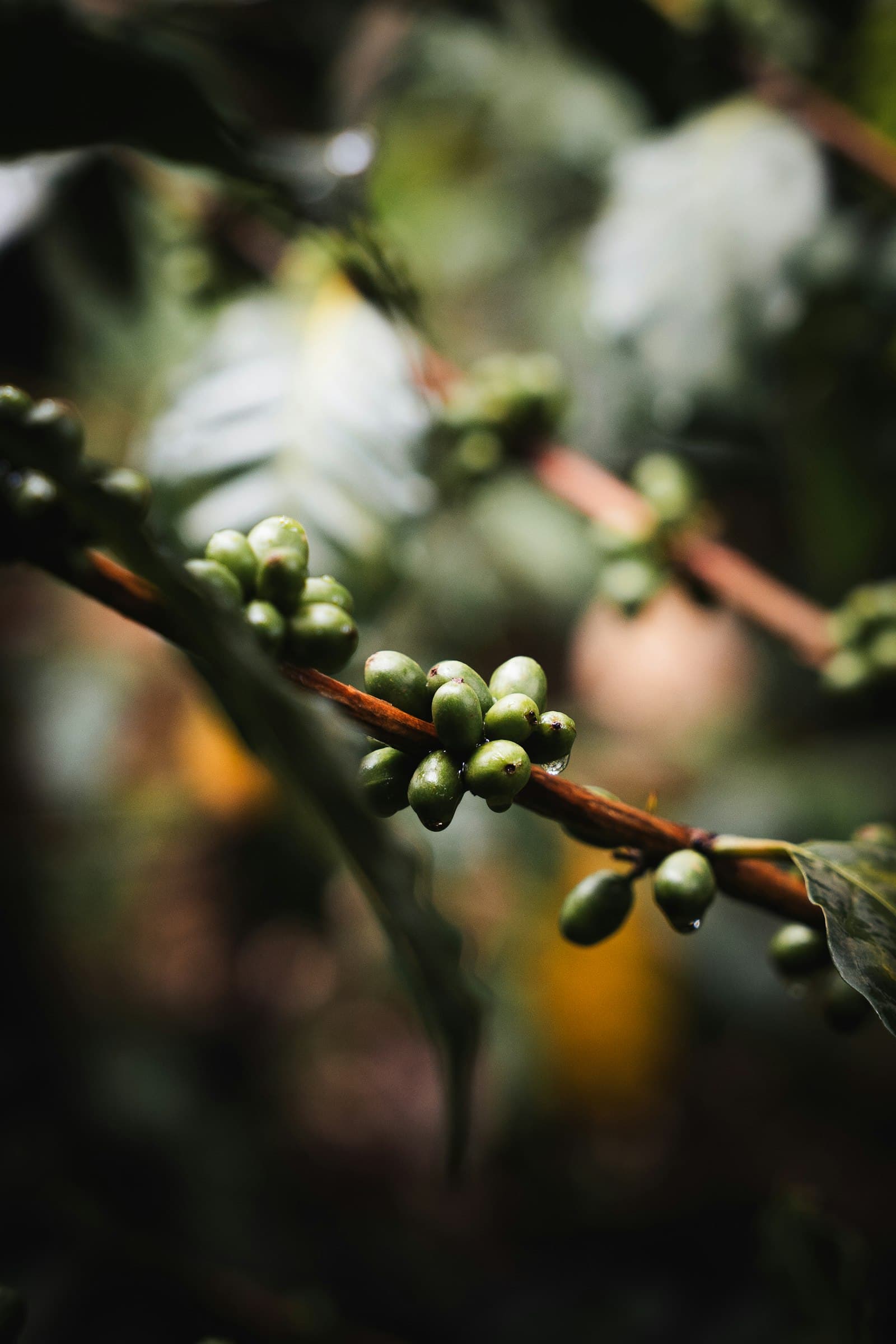
A coffee cherry usually holds two facing seeds (flat beans). Sometimes, due to pollination quirks, only one seed develops and grows round — that is the “peaberry (PB).” Only a few percent of the crop, they are sorted out separately. It is often said that “the round shape concentrates nutrients for a richer flavor,” but that is not scientifically proven — just a popular belief. Still, peaberries are uniform in size, so they roast more evenly, and Tanzania has established the peaberry as a brand.
Two regions — north and south
North — Kilimanjaro, Arusha, Meru
The face of Tanzanian coffee. Grown on the volcanic soils of Mt. Kilimanjaro and Mt. Meru at 1,400–2,000m, the Arabica here stands out for a Kenya-like bright acidity and blackcurrant fruit. The hub town of Moshi is the center of Tanzanian coffee.
South — Mbeya, Mbinga, Songwe
The southern highlands have risen in specialty esteem lately. Mbeya and Mbinga (Ruvuma) yield clean lots rich in chocolate and sweetness, with a growing presence at the Cup of Excellence. It is also one of the country’s largest growing areas.
Grading — AA, AB, PB
Like Kenya, Tanzania grades by bean size (screen size). Knowing the marks you often see on labels makes choosing easier.
- AA: the largest beans (screen 17/18). The flagship grade that looks good and fetches high prices
- AB: a bit smaller than AA, the central grade with the most volume
- PB (peaberry): a special lot of sorted round single beans — Tanzania’s specialty
- Note: AA is a size grade and does not directly indicate how good the cup tastes
Main varieties
- Bourbon / Kent: long-standing varieties with a good flavor reputation; Kent is relatively disease-tolerant
- N39 / KP423: lines selected and spread within Tanzania
- New varieties (TaCRI): disease-resistant compact varieties bred by the Tanzania Coffee Research Institute
History and cooperatives
Coffee was introduced by missionaries in the 19th century and expanded under German and British colonial rule. Notable is the cooperative tradition: the KNCU (Kilimanjaro Native Cooperative Union), founded in 1925, is one of Africa’s oldest cooperatives. A system of smallholders pooling cherries to process and ship together took root early. Moshi’s auction has also been a driver of quality.
Recommended brewing
To make the most of Tanzania’s bright acidity and fruit, paper drip that extracts cleanly (V60 and the like) is the royal road. A light to medium roast and a slightly higher water temperature suit it.
Basic V60 ratio (1:16)
Beans 15g / Water 240g
- Roast: light to medium to bring out fruit and bright acidity; a dark roast buries the character
- Water temp: a slightly higher 92–94°C to draw out citrus and blackcurrant flavors
- Brewing: clean paper drip; iced makes the fruit stand out
- Side-by-side: tasting it against Kenya reveals the difference in acidity and “drinkability”
Frequently asked questions
Is peaberry really better?
The belief that “round beans concentrate flavor for a richer cup” is not scientifically proven. That said, because they are uniform in size they roast more evenly, which can lead to a more consistent tastiness. With their scarcity and brand power, it is about right to treat Tanzanian peaberry as “a signature worth trying.”
How does it differ from Kenya?
The direction is similar (bright acidity, blackcurrant, structured taste). But Tanzania doesn’t jut out as far in acidity and fruit as Kenya, tending to be a little gentler and more drinkable. For someone who finds “Kenya a bit too strong,” Tanzania is a just-right entry point. For the difference, see our Kenya deep dive and the Ethiopia vs Kenya comparison.
Because the name “Kilimanjaro” looms so large, the substance of Tanzania — the north-south difference and the peaberry culture — is surprisingly little known. Next time you spot “Kilimanjaro” or “Tanzania AA / PB,” pay attention to the region (north or south) and the grade. Even within one country, you will meet surprisingly different faces.
Was this article helpful?
Choose & compare
Related links
More articles
The Coffee Variety Family Tree — Reading the “Genealogy” That Begins with Typica and Bourbon
BeansThe Coffee Belt and Terroir — Why Coffee Grows Only in the “Equatorial Band,” and Why Each Origin Tastes Different
BeansThe Science of Coffee Acidity — What Fruitiness Really Is, and How It Differs from “Sour”
BeansKenya Coffee Deep-Dive: The Source of That Powerful Acidity and “Tomato” Complexity