Coffee Cupping 101: Train Your Palate with the Pros’ Evaluation Method
Slurp from a spoon and score it — how to put flavor into words and find the shape of your taste
Cupping is the “shared language of tasting” by which roasters, buyers and Q-graders evaluate and score coffee through a single standard procedure. It needs almost no special equipment, and you can do it at home. Line up several coffees under identical conditions and the differences become words with startling ease, and the shape of [your own taste](/articles/find-your-taste) comes into focus. From the SCA-style standard procedure to slurping technique, putting flavor into words, and a simplified home version — here’s how to train your palate through cupping.
Contents · 9
“This coffee is delicious” — but putting into words exactly what is delicious is hard. The method to break through that wall is “cupping.” It’s the way roasters, buyers and trained Q-graders evaluate and score coffee through a single standard procedure — a shared language of tasting, you might say. It needs almost no special gear and can be done at home. Line several coffees up under identical conditions and the differences in taste turn into words with startling clarity, and the shape of your own taste comes into view.
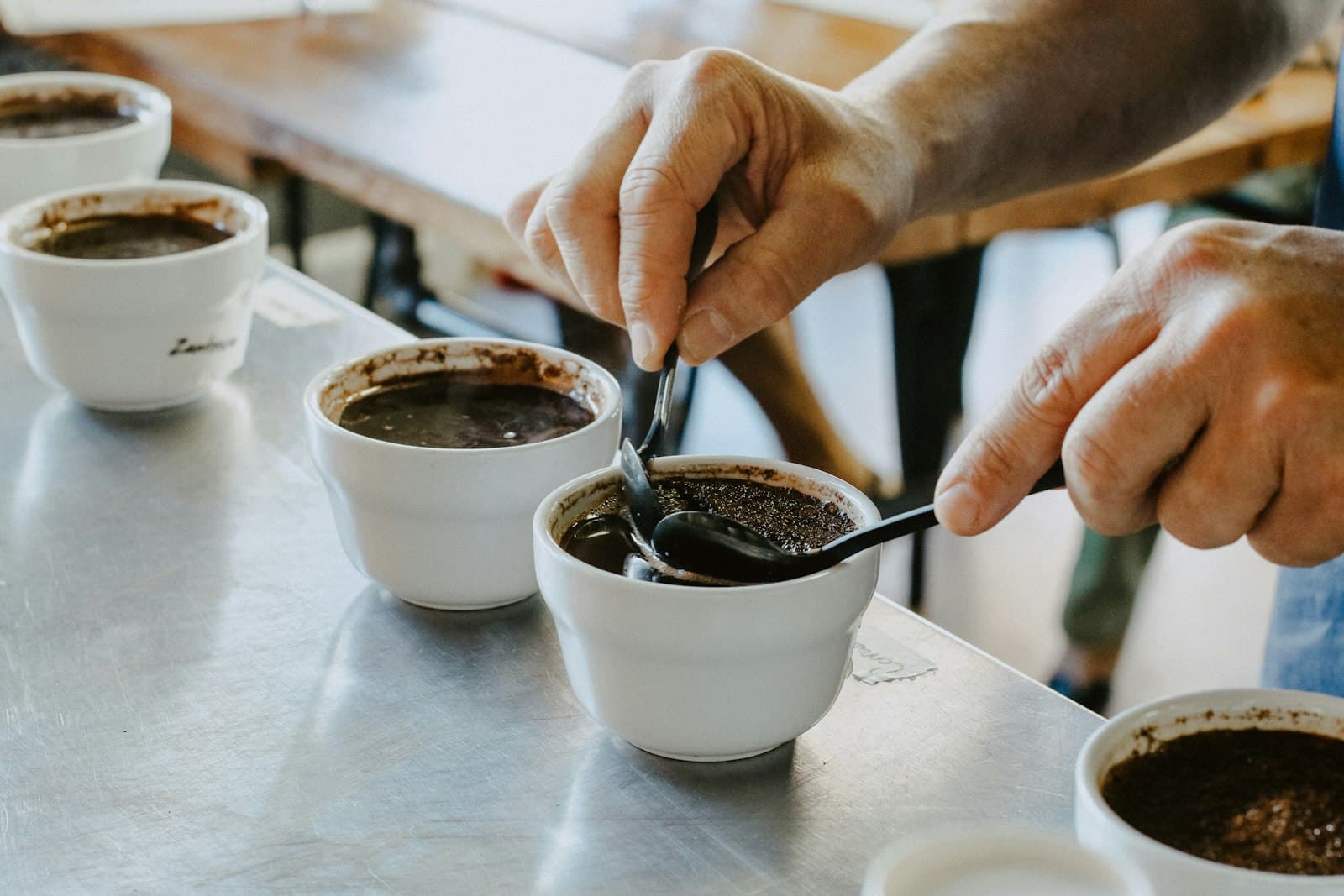
What cupping is — the language the pros use
- Purpose: a standard procedure to measure coffee quality in a form anyone can compare
- Who uses it: roasters, green buyers, Q-graders, competition judges
- Strength: brewing at the same dose, water, temperature and time throws the bean’s own differences into relief
- Side benefit: the more you do it, the more your vocabulary grows and your tastes and blind spots appear
The world standard for cupping is the SCA (Specialty Coffee Association) protocol. You score out of 100, and 80+ counts as “specialty.” Behind that number is the procedure introduced in this article. The scoring side is covered in detail in What “specialty” means, and grading.
Why it’s worth doing at home
An everyday cup mixes in your skill at brewing and your gear’s quirks, making the bean’s own taste hard to see. Cupping fixes the conditions completely, so you can fairly compare “what character does this bean have.” Drinking 3–4 side by side, the shape of your taste — whether you love acidity or love body — comes into focus with surprising clarity.
- Palate training: side-by-side comparison reveals differences far better than drinking one at a time
- Fair comparison: removes the variance of brewing and shows only the bean’s character
- Finding your taste: which of origin, processing or roast level suits you comes into view
- Smarter shopping: the words on the label start to connect with the actual taste
What you need
- Several cups or bowls of the same shape and capacity (one per coffee evaluated)
- Spoons (a cupping spoon is ideal, but a round tablespoon works)
- A scale and grinder, a kettle, a thermometer (if you have one)
- Hot water to rinse the spoon, and water to reset your palate
- A notebook (jot down aroma, acidity, sweetness, body, aftertaste)
The standard procedure (SCA style)
The base ratio is “8.25g of grounds plus 150ml of water (about 1:18).” Grind coarse (about coarse salt) and use water around 93°C. Prepare several bowls and compare under identical conditions. First, learn the flow.
Cupping standard (about 1:18, per bowl)
Beans 8g / Water 150g
1. Smell the dry grounds (fragrance)
Before pouring, smell the ground coffee. This is the “fragrance.” Fruity, nutty, toasty? Note your first impression. Line up several bowls and you’ll find there are already differences at the dry-grounds stage.
2. Pour water and smell the “crust” (aroma)
Pour 93°C water in one go until the grounds are submerged. The grounds form a layer (the crust) on the surface. The smell rising as they take on water is the “aroma.” Bring your nose close and check the scent in this wet state.
3. “Break” it after 4 minutes
After waiting 4 minutes, push the crust back about three times with a spoon to break it. The aroma that rises all at once here is the richest moment — lean in and inhale deeply. Once broken, skim off the foam and grounds (the “scum”) floating on the surface with two spoons.
4. Once it cools, “slurp”
When it has cooled to around 70°C, scoop a spoonful and slurp it in sharply with air, with a “slurp!” The point is to spray the liquid as a mist across your mouth. With your whole tongue and the back of your nose (retronasal), check acidity, sweetness, body, flavor and aftertaste.
5. Evaluate repeatedly as it cools
Coffee changes its face with temperature. Hot, the acidity is bright; as it cools, sweetness and defects become clearer. Slurp the same bowl three times — warm, lukewarm and cool — to see the bean’s true nature.
There’s a reason to “slurp.” Misting it spreads it into every corner of the mouth while sending aroma up the back of the nose (retronasal olfaction). That’s the trick to perceiving flavor in three dimensions. You’ll splatter your clothes at first, so practice in front of the sink.
What you evaluate — the SCA attributes
- Fragrance / Aroma: the smell of the dry and wet grounds
- Flavor: the overall taste in the mouth
- Aftertaste: the quality and length of the lingering finish after swallowing
- Acidity: brightness and quality — judge “quality,” not quantity
- Body: the weight and texture in the mouth
- Balance: the harmony of the elements
- Sweetness / Clean cup / Uniformity / Overall
The SCA method scores these and totals them out of 100, with 80+ as the specialty threshold. At home, rather than strict scoring, simply noting each attribute as “strong / weak” or “like / dislike” is plenty useful.
Putting flavor into words — the flavor wheel
Putting what you sense into words is hard until you get used to it. That’s where the “flavor wheel” comes in. Move from the central broad categories (fruity / floral / nutty-cocoa / spice / sweet…) outward to the specific words (berry, citrus, jasmine, almond, chocolate…), and a vague impression becomes language. This site’s flavor wheel and world coffee flavor data are also clues for vocabulary.
- Fruity: berry, citrus, stone fruit, tropical
- Floral: jasmine, black tea, chamomile
- Nutty / cocoa: almond, hazelnut, chocolate, cocoa
- Spice / sweet: cinnamon, brown sugar, honey, maple
- Note: it’s not a game of guessing the “right answer” — your own words are fine
A simple home cupping (no scoring)
- Prepare 3–4 coffees (differing origin or processing makes differences clearer)
- Brew at the same dose, grind, water, temperature and time (fix the conditions completely)
- If you can, have someone rearrange the cups and hide the names — go “blind”
- Note aroma, acidity, sweetness, body and aftertaste, and rank them
- Reveal the names at the end. The tendency of your taste comes into view
Going blind (hiding the names) erases the bias of “it’s expensive” or “it’s a famous origin,” leaving only your tongue’s judgment. Don’t forget to drink water in between to reset your palate.
Common failures and fixes
Everything tastes the same
- Fix 1: choose beans of differing character (an African light roast × a Central American × a dark roast)
- Fix 2: drink repeatedly at different temperatures; gaps widen as it cools
- Fix 3: compare one attribute at a time — acidity, sweetness, body — rather than all at once
Can’t slurp well / it makes you choke
Everyone chokes at first. Take just a little on the spoon and draw it in with a short, sharp “slurp,” as if inhaling air just in front of your lips. If you can mist it, you’ve got it. Practice casually in front of the sink and you’ll get used to it in a few tries. There’s no need to force a loud noise.
Frequently asked questions
Is it impossible without special tools?
No. Line up same-shaped cups (mugs or teacups work) for the number of coffees and have a round spoon, and you can begin. What matters is not the tools but “fixing the conditions completely.” If you can lock down dose, grind, water, temperature and time, that’s a fine cupping.
Swallow, or spit?
Pros evaluate dozens a day, so to avoid caffeine they usually spit. For a few coffees at home, do as you like. Swallowing lets you judge the aftertaste and finish, and with small amounts caffeine is no concern. You could also keep a dedicated spit cup.
How does cupping differ from an everyday cup?
Cupping is a “brewing for evaluation,” showing the bean’s bare form under uniform, immersion-like conditions. An everyday drip or espresso is a “brewing for enjoyment,” shaping the taste with gear and skill. Learn a bean’s character through cupping, then finish it to taste with a drip — that round trip sharpens your resolution on coffee fast.
Cupping is like strength training for the tongue. Even if you can’t tell the differences at first, the words catch up as you continue: “ah, this is berry,” “this one’s a nutty sweetness.” Just line up three on a weekend. Once you can describe your taste in your own words, choosing coffee becomes far more free and fun.
Was this article helpful?
Origins in this article
Choose & compare
Related links
More articles
The Coffee Variety Family Tree — Reading the “Genealogy” That Begins with Typica and Bourbon
BeansThe Coffee Belt and Terroir — Why Coffee Grows Only in the “Equatorial Band,” and Why Each Origin Tastes Different
BeansThe Science of Coffee Acidity — What Fruitiness Really Is, and How It Differs from “Sour”
BeansArabica vs. Robusta: How They Differ in Taste, Caffeine, Price and Appearance