Arabica vs. Robusta: How They Differ in Taste, Caffeine, Price and Appearance
The two species that split the coffee world — what differs, and why
There are hundreds of coffee varieties, but commercially almost everything is one of two species: Arabica and Robusta. They differ as plants, in flavor, in caffeine and in price. Why they differ, how to tell them apart, and whether the old “Robusta = low quality” line still holds — here are the fundamentals.
Contents · 10
- The big picture: a quick comparison
- Differences as a plant (which is why growing conditions differ)
- Taste: acidity and aroma for Arabica, body and bitterness for Robusta
- Caffeine: Robusta has about twice as much
- Why the prices differ
- Where is each used?
- Telling them apart by bean and label
- Is “Robusta = low quality” outdated? The rise of fine Robusta
- So which should you choose?
- FAQ
Ever seen a label that says “100% Arabica”? Coffee has hundreds of varieties, but almost everything traded in the world is one of two species — Arabica (Coffea arabica) and Robusta (Coffea canephora, commonly “Robusta”). Though both are “coffee,” they differ in everything from the plant itself to flavor, caffeine and price. Understanding the difference sharpens how you choose beans.
Arabica and Robusta make up almost 100% of world coffee production — roughly 60% Arabica, 40% Robusta. Most beans sold as specialty single origins are Arabica; Robusta shows up in instant and canned coffee, and in part of some espresso blends.
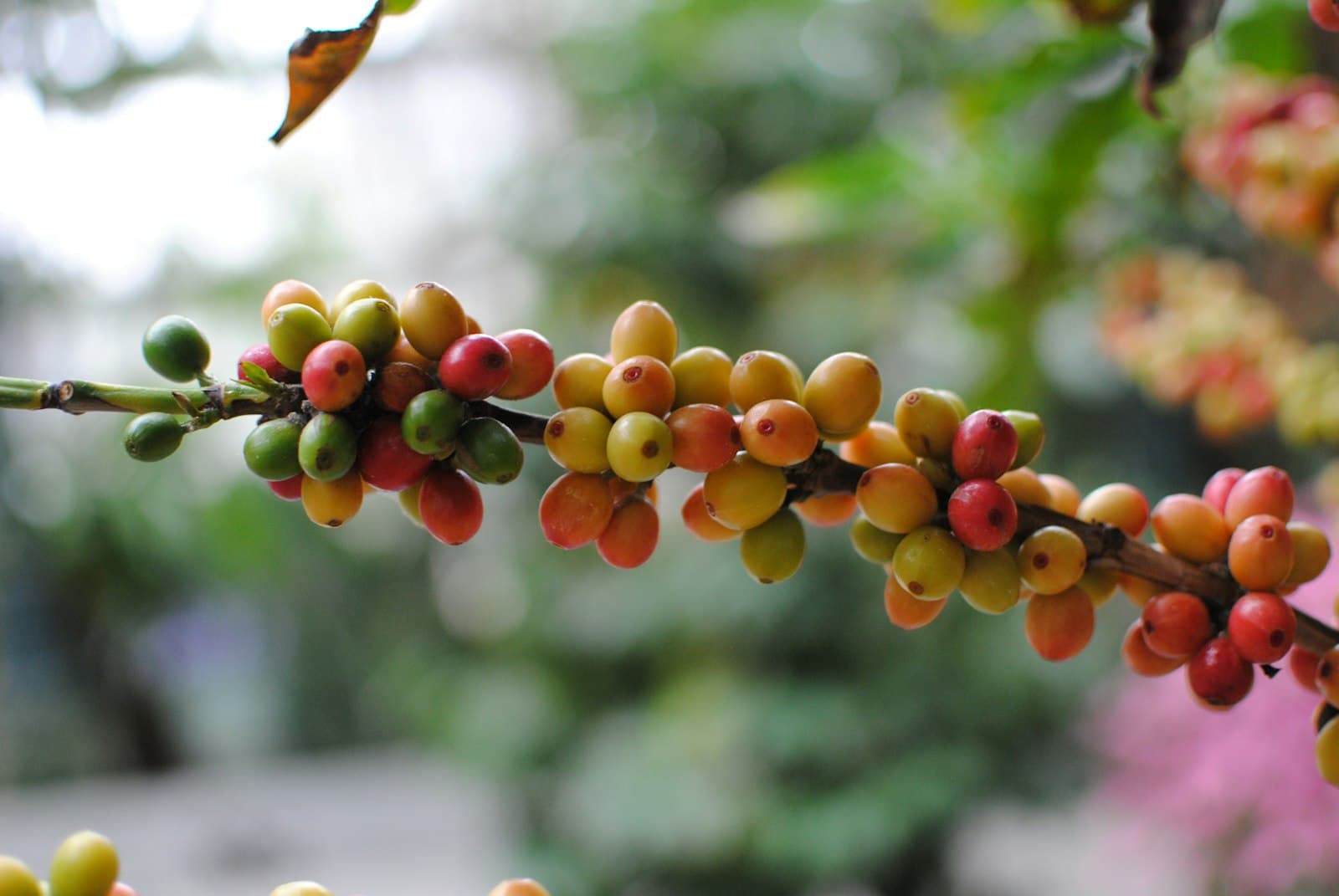
The big picture: a quick comparison
- Arabica — suited to highlands at 1,000–2,000m. Rich, complex acidity, aroma and sweetness. Disease-prone and labor-intensive. The star of specialty
- Robusta — grows even in lowlands (0–800m). Strong bitterness and body, plain aroma. Resistant to disease and heat, high yield. Cheap and built for volume
- Caffeine — Robusta has about twice that of Arabica, part of why it is bitter and hardy
- Price — at the same grade Arabica costs more; Robusta trades mostly as a commodity
Differences as a plant (which is why growing conditions differ)
Arabica and Robusta differ right down to their chromosomes. Arabica is a tetraploid with 44 chromosomes and self-pollinates; Robusta is a diploid with 22 and cross-pollinates. Arabica has less genetic diversity, is delicate, and is weak to disease and heat. Robusta is hardy (robust — hence the name) and thrives even in hot lowland environments.
- Altitude: Arabica = highlands (quality improves above 1,000m) / Robusta = even lowlands
- Ideal temperature: Arabica = a cool 15–24°C / Robusta = a hot, humid 24–30°C
- Disease resistance: Arabica = weak to leaf rust and others / Robusta = strong (more caffeine and chlorogenic acid)
- Yield: Arabica = lower / Robusta = higher — one reason for the price gap
“The higher-grown the coffee, the better it tastes” is mainly an Arabica story. The higher the altitude and the wider the day-night temperature swing, the more slowly the bean matures, storing sugars and acids for a more complex flavor. Robusta is a lowland species to begin with, so this yardstick doesn’t apply.
Taste: acidity and aroma for Arabica, body and bitterness for Robusta
The flavor difference is the easiest to feel. Arabica offers bright acidity, a fragrant aroma, natural sweetness and complexity — fruit and floral nuances are an Arabica signature. Robusta centers on firm bitterness, a heavy body, and plain notes of nuts, grain, rubber and earth, with little aromatic flourish.
- Arabica — acidity ◎ aroma ◎ sweetness ◎ complexity ◎, gentle bitterness. Enjoy its character as a single origin
- Robusta — bitterness ◎ body ◎, crema comes easily. Plain aroma. For better or worse, the bold “this is coffee” taste
- When it goes wrong — low-grade Robusta tends to show “rubber,” “burnt tire” or “barley tea” notes
Caffeine: Robusta has about twice as much
For the plant, caffeine is a defense against insects. Growing in pest-heavy lowlands, Robusta carries more caffeine than Arabica.
As a rough guide per dry bean weight, Arabica is about 1.2–1.5% and Robusta about 2.2–2.7%. Brewed the same way, a Robusta blend has more caffeine. For a clean night’s sleep or to cut caffeine, 100% Arabica (or decaf) is the safe pick. See our caffeine and sleep article for more.
Why the prices differ
Arabica costs more not just for its flavor reputation but for how hard it is to grow: good quality only at altitude, weak to disease, low yield, and largely hand-picked, which adds labor cost. Robusta is cheap because it can be produced efficiently in lowlands at scale, even with mechanical harvesting. Even on global markets, Arabica (New York) and Robusta (London) trade separately.
- Why Arabica is pricey: high-altitude growing, mostly hand-picked, disease risk, low yield
- Why Robusta is cheap: lowlands, mass production, easy to mechanize, high yield
- Separate markets: Arabica and Robusta are priced on different futures exchanges
Where is each used?
Knowing the uses reveals how the two species divide the work. Specialty and roastery single origins are basically Arabica. Robusta, with its stable bitterness, body and easy crema (the espresso foam), is added in small amounts to some espresso blends and is a main ingredient in instant, canned and bottled coffee. Traditional Italian espresso often blends in Robusta on purpose for body and crema.
Telling them apart by bean and label
You can tell them apart somewhat by the roasted bean’s shape. It’s clearer with green beans, but these cues are handy to remember.
- Bean shape: Arabica = a slightly elongated oval with an S-curved center cut / Robusta = rounder with a straight center cut
- Label: “100% Arabica” or “Arabica” means Arabica only. A cheap blend with no such note may contain Robusta
- Price and use: extremely cheap regular coffee and instant often have a high Robusta share
Is “Robusta = low quality” outdated? The rise of fine Robusta
For a long time Robusta was a byword for “cheap and nasty.” But carefully grown and processed high-grade Robusta — Fine Robusta — is gaining recognition. India’s Kaapi Royale, certain lots from Uganda and Indonesia: clean, defect-free Robusta lends espresso thickness and a sweet depth. The SCA (Specialty Coffee Association) has even been building Fine Robusta evaluation standards, and “Robusta = low quality” is slowly becoming a thing of the past.
One major home of fine Robusta is India. For the world of distinctive Robusta like monsooned coffee, see our India deep-dive; for the lineage of varieties overall, see the coffee varieties guide.
So which should you choose?
- Want aroma, acidity and origin character → a 100% Arabica single origin
- Want a bold, bitter cup that holds up to milk → a Robusta-blended espresso blend
- Want to cut caffeine → 100% Arabica, or decaf
- Value cost and drink a lot daily → an affordable Robusta-blended option is also worth considering
FAQ
Is Robusta bad for you?
It is not bad for you. That said, it has more caffeine and chlorogenic acid than Arabica, so if you are sensitive to caffeine, watch the amount. "The harshness of low-quality Robusta" and "health effects" are separate matters — a clean fine Robusta lets you enjoy the richness without any off-flavors.
Is instant or canned coffee which one?
Most are Robusta-based or Robusta-blended — for low cost, solid bitterness and consistent quality. That said, instants and cans advertising "100% Arabica" have increased lately. The label tells you the direction of the blend.
Is decaf Arabica or Robusta?
Both exist. Specialty decaf tends to be Arabica-based; Robusta, already high in caffeine, puts a heavier load on the removal process. How to choose, including the method, is covered in detail in how to choose decaf.
Arabica and Robusta aren’t better-or-worse but “different roles” — the elegance of Arabica, the power of Robusta. Which is right depends on what you want from the cup. Next time you buy, check the “Arabica 100%” note on the label and see which way your taste leans.
Was this article helpful?
Choose & compare
Related links
More articles
Panama Coffee Deep Dive — The Volcanic Highlands That Bore Geisha, and the Story of the World’s Highest Price
BeansThe Coffee Variety Family Tree — Reading the “Genealogy” That Begins with Typica and Bourbon
BeansThe Coffee Belt and Terroir — Why Coffee Grows Only in the “Equatorial Band,” and Why Each Origin Tastes Different
BeansThe Science of Coffee Acidity — What Fruitiness Really Is, and How It Differs from “Sour”