Starting Espresso at Home: Your First Gear and How to Pull a Shot
A world of 9 bars, 25 seconds and concentration. Get ahead of the 3 common pitfalls first
Home espresso is not "buy a machine and you're done." What actually decides the taste is the grinder. We explain the basic recipe (1:2, 25–30 seconds) and, ahead of time, the three failures beginners always hit.
Contents · 8
That rich café cup, at home too ──. Home espresso gets more affordable year by year, but it takes a skill completely different from drip. Knowing first "what to spend on and what to protect" lets you avoid pointless detours.
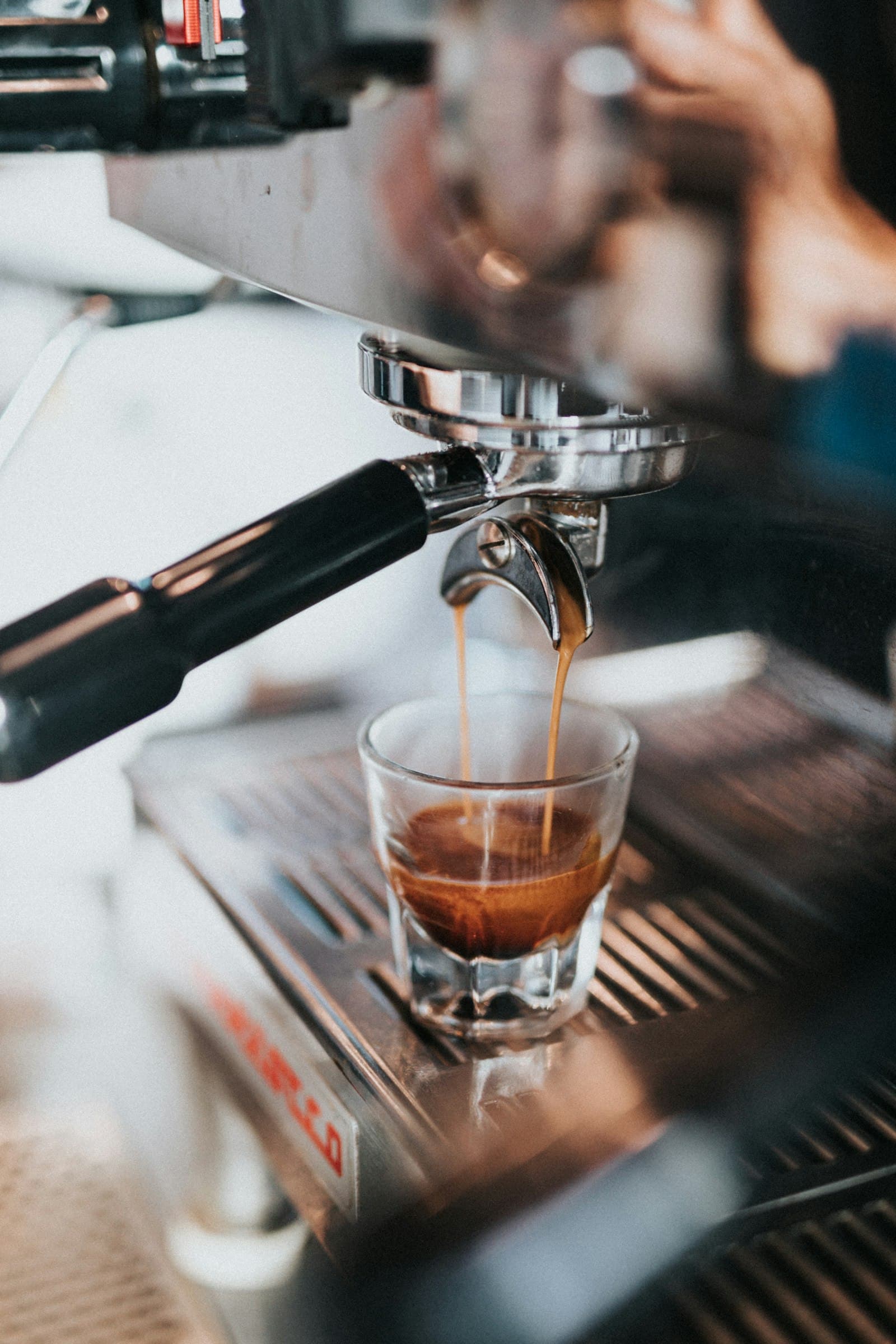
What is espresso?
Espresso is a brewing method that passes water under about 9 atmospheres of pressure through finely ground, compacted grounds in 25–30 seconds. Because it squeezes out the compounds at once under short, high pressure, you get a concentrated liquid wearing crema (golden foam) on the surface. Its hallmark is condensed flavor in a small volume.
The gear you need (in priority order)
- Espresso machine: one that delivers 9 bars stably. Semi-automatic is the basis
- Grinder (most important): a burr grinder with espresso-capable fine grinding and fine adjustment. More important than the machine
- Tamper: a tool to compress the grounds evenly. One that fits the basket diameter
- Scale: to 0.1g. Essential for measuring dose and yield
If torn on budget allocation, weight the grinder over the machine. A cheap machine + a good grinder pulls better than an expensive machine + a cheap grinder, because espresso's taste is decided by the precision of the grind.
Realistic builds by budget
- Up to ¥50,000: a compact semi-automatic machine + a hand-cranked espresso-capable grinder. Enough for practice, but accept compromises in temperature and pressure stability
- ¥50,000–120,000: a standard entry semi-automatic + an electric espresso grinder. From here you can stably pull a cup "close to a café"
- From ¥120,000: a machine with PID temperature control + an upper-tier grinder. The range of fine-tuning widens, drawing out even single-origin character
The common idea is "the machine to your means, the grinder one tier up." Because the success of espresso is mostly decided by the state of the grounds, allocating more to the grinder side for the same total gives higher satisfaction. Pairing a used or previous-gen machine with a good new grinder is a smart move too.
The basic recipe (double)
The most reproducible starting point is "18g of grounds → 36g of liquid in 25–30 seconds." This is a 1:2 ratio of grounds to liquid, the classic espresso recipe. Use it as your baseline and fine-tune the grind while watching the taste.
Espresso 1:2 (double)
Beans 18g / Water 36g
Three failures beginners hit
- Grind too coarse → the water rushes through and it ends in 10 seconds. Thin and sour. Fix: finer
- Grind too fine → it clogs and takes over 40 seconds. Strong, bitter, burnt-smelling. Fix: coarser
- Channeling → uneven grounds let water through only part of the puck. Prevent it with even tamping and leveling
The extraction time (seconds) is a result, not a target. If you "want to land in 25–30 seconds," adjust the grind, not the time itself.
Combining with milk (latte, cappuccino)
Steam the milk to a guide of 60–65°C to make fine "microfoam." Overheat it and the sweetness flies off and the protein denatures, giving harshness. Café latte is roughly espresso:milk = 1:4; cappuccino is roughly equal parts espresso, steamed milk and foam.
One more level of adjustment: pre-infusion and water temperature
Once used to the basics, two variables extend the taste further. One is "pre-infusion (a pre-soak)." Wetting the whole puck evenly with low-pressure water for a few seconds before the main shot reduces channeling and increases sweetness and uniformity. The other is water temperature: a guide of 94–96°C for light roasts, 90–92°C for dark. The higher it is, the more readily compounds come out, and lowering it for dark roasts is to hold back bitterness. To push further, switching to a "precision basket (VST and the like)," where the puck swells evenly, raises stability.
FAQ
How is it different from a capsule machine?
Capsules are appealing for ease and consistency, but you cannot choose the bean, grind or dose. A semi-automatic, for all the effort, has incomparably more freedom of adjustment and draws out a fresh bean you love at its best. Whether you can enjoy "the process of brewing" is the dividing line. See espresso vs drip for the difference in strength and taste.
How much does one cup cost?
About ¥40–70 per 18g of beans (even with specialty). Counting a café latte at several hundred yen, if you drink daily the gear pays back faster than you would think.
Is maintenance hard?
Clean the basket every time, "backflush" about once a week, and periodically replace the gasket and "descale (remove limescale)." Neglect this and the extraction goes cloudy and causes off-flavors. Keeping the tools clean is part of the taste.
Why does the crema not form, or vanish quickly?
The amount and staying power of crema are decided mainly by "bean freshness" and "grind." The fresher the bean since roast, the more CO2 it holds and the more stably a fine crema forms. Conversely, with old beans or too coarse a grind you only get a thin, fleeting crema. Using fresh beans about 2–4 weeks off roast and matching the grind so extraction lands in 25–30 seconds is the shortcut to crema.
Dark or light roast — which suits espresso?
For beginners, dark to medium-dark is easier to handle. Dark roast gives up its compounds readily, so even if the grind drifts a little it makes a stable, sweet, rich cup, and pairs well with milk. Light roast, on the other hand, is more acidic and harder to extract, but offers a fruity, showy "modern espresso." The recommendation is to solidify the basics with dark roast first, then take on light roast once used to it.
Can I get close to espresso without a machine?
A full reproduction is hard, but you can get close. A moka pot (stovetop), or manual espresso makers like an AeroPress with a pressure adapter or a Flair, can make a concentrated cup. It will not reach 9 bars and true crema, but combined with milk it is plenty to enjoy a "strong latte." Starting with a moka pot is the easiest.
Espresso is not "leave it to the machine" but a dialogue-like extraction where you match the grind and dose each time. The first few dozen cups are failures as a matter of course. As long as you hold the north star of 1:2, 25–30 seconds, you will surely reach a stable cup.
Was this article helpful?
Choose & compare
Related links
More articles
The Science of Extraction — What, and How, Hot Water Draws Out of Coffee: Dissolution, Diffusion and Yield
BrewingComplete Guide to Nel Drip — The Kissaten’s “Velvety Cup” at Home
BrewingThe Complete Guide to Dialing In Espresso: The Science of Fixing Sour and Bitter Yourself
BrewingThe Coffee-to-Water Ratio: Set Your Flavor by the Numbers, From One Cup to a Crowd