The Complete Chemex Guide: How a Thick Filter Brews a Cup of Pure Clarity
A device designed by a chemist — its proprietary filter and one-piece carafe make clean, sweet coffee
An hourglass glass curve and a wooden collar — the Chemex, designed in 1941 by a chemist and now in the permanent collection of New York’s Museum of Modern Art, is a touchstone of functional beauty. Its defining feature is a proprietary filter 20–30% thicker than usual, which traps oils and fines to brew a cup as clear and sweet as tea. From dialing in grind, temperature and ratio to handling its tendency to clog, here is the full method for mastering the Chemex.
Contents · 10
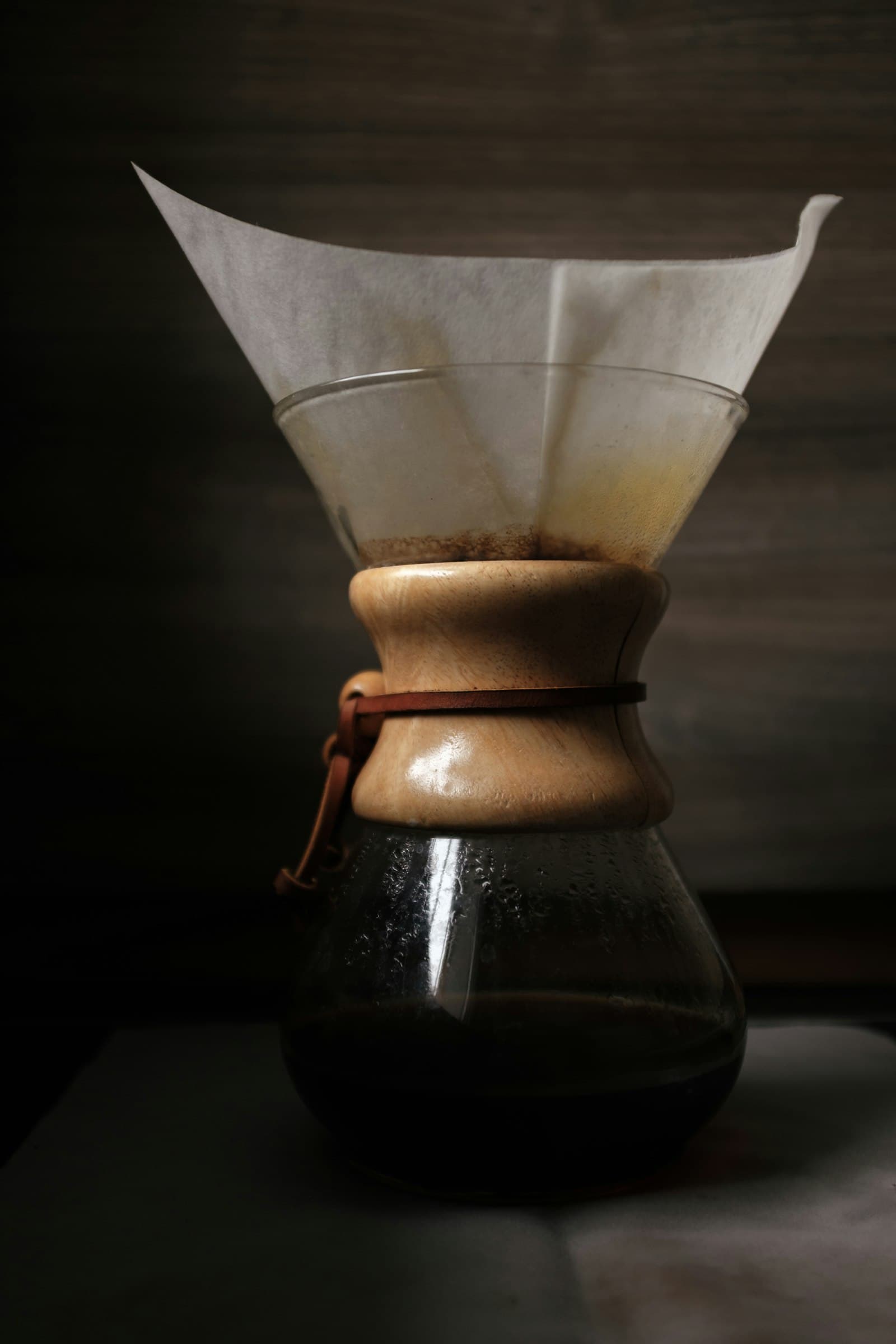
A waisted hourglass of glass, a wooden collar and a leather tie — the Chemex has a form you never forget. It is not a looks-only device. Designed in 1941 by German-born chemist Peter Schlumbohm and held in the permanent collection of New York’s Museum of Modern Art (MoMA), it is a classic where function and form align. The cup it pours has a “clarity” unlike ordinary paper drip — and the secret is its thick proprietary filter.
Why the Chemex is special (a quick reference)
- One-piece carafe: dripper and server are a single piece of glass, with a molded spout and an air channel
- A thick proprietary filter: 20–30% thicker than typical paper, filtering oils and fines hard for an extremely clean cup
- Taste profile: clear like tea, with little off-flavor or bitterness; bright acidity and sweetness stand out; light body
- Best beans: light-to-medium specialty. The character of a fruity single origin shines
- Several cups at once: sizes from 3 to 10 cups, so you can brew a batch for guests
Peter Schlumbohm, who designed the Chemex, applied the principles of the laboratory Erlenmeyer flask and funnel directly to an everyday object. True to a name rooted in “Chemistry,” a lab-like rationality sits at the root of its form — which is why the design hasn’t changed in over 80 years and hangs in a museum.
Anatomy and lineup
The Chemex is a glass vessel where the dripper and server are one. You set the filter in the upper cone and add grounds; the brew collects in the lower flask. The wooden collar (woodneck) doubles as a handle and a pouring point, so you can pour safely even when the glass is hot.
- Classic (woodneck): the standard model with a wooden collar and leather tie. 3, 6, 8 and 10-cup sizes
- Glass handle: a model with a molded glass handle, easier to put in the dishwasher
- Hand-blown: a higher-end model blown by an artisan, with a thinner, more delicate form
- Sizing: a “6-cup” serves about 3–4 people (a “cup” here is a small ~150ml measure, so estimate actual servings lower)
The filter decides the taste
What defines a Chemex cup is its thick proprietary bonded filter. It is 20–30% thicker and finer than typical paper, so it traps coffee’s oils and fine particles more thoroughly than usual. The result is a clear cup with no cloudiness or off-flavor and sharp definition. Once you understand how paper filters differ, you see just how much that thickness matters.
- Shape: folded into a cone. Set the “thick side,” where three layers meet, facing the carafe’s spout
- Types: brown natural (unbleached) and white bonded (bleached); pre-folded, square and circular
- The price of clarity: trapping oils means a lighter body — sometimes too light for those who want richness
- On substitutes: the thickness is the heart of the taste, so thin generic paper won’t deliver the “Chemex character”
Filter orientation matters more than you’d think. Put the folded “thick side,” where three sheets overlap, toward the carafe’s spout. This keeps the paper from sealing too tightly to the glass and blocking the air channel, so water flows smoothly.
What you need
- A Chemex (6-cup) and its proprietary filters
- A gooseneck kettle (easy to control volume and pour position)
- A scale (manage dose, water and time by the numbers)
- A grinder (a uniform medium-coarse; grind consistency is the key to repeatability)
- Fresh light-to-medium roast beans (their fruity character shines)
Basic recipe (6-cup / about 3–4 servings)
The first step is being able to reproduce this ratio and procedure reliably. Use about 1:16 (1 part coffee to 16 parts water) as your baseline.
Baseline for 6 cups (about 1:16.7)
Beans 42g / Water 700g
- Coffee: medium-coarse, 42g (a step coarser than V60, about like coarse salt)
- Water: 92–96°C, 700g total
- Rinse the filter to flush papery taste and preheat the carafe
- Add grounds and bloom with 100g of water for 30–45 seconds
- Pour in stages from the center in spirals, keeping the level up, to 700g
- Target total brew time: about 4 to 4.5 minutes
The procedure broken into five steps
1. Rinse the filter
The thick filter releases papery flavor easily, so always rinse it. Set the filter, pour hot water around it to flush the papery taste and preheat the whole carafe at the same time. Tip the carafe to discard the rinse water. This one step raises clarity a notch.
2. Add grounds and bloom
Add the grounds level, then wet them all with about twice their weight in water (here, 100g) and wait 30–45 seconds. The fresher the beans, the more they swell with CO2; degassing well here reduces unevenness in the main pour.
3. Pour from the center in spirals
Once the bloom settles, pour slowly in spirals from the center outward. Pouring directly onto the paper lets water bypass the grounds down the side and dilute the cup, so avoid the very edge.
4. Pour in stages, keeping the level up
Don’t pour it all at once; add the next pour before the level drops fully, keeping the slurry (the layer of grounds and water) at a steady height. Reach 700g over a few pours (2–4). The thick filter drains slowly, so keep a calm, even rhythm.
5. When it has drained, swirl the carafe and serve
When the water has drained through, remove the filter, swirl the carafe gently to even out the concentration, then pour. The one-piece glass is beautiful and goes straight to the table — another of the Chemex’s charms.
Adjusting grind, temperature and ratio
Because the thick filter flows slowly, set the grind a step coarser than for a V60. Too fine and it clogs and over-extracts (astringency, bitterness). Remember the three dials that move the taste.
- Grind: medium-coarse (about coarse salt). Coarser if it drains slowly or tastes bitter; a touch finer if weak
- Temperature: 92–96°C. Higher for light roasts, lower for dark (the science of water temperature)
- Ratio: tune within 1:15 (stronger) to 1:17 (cleaner) to taste
- Pour: slow and center-focused for sweetness; faster and wider for a cleaner, lighter cup
If it drains extremely slowly or stalls midway, the grind is almost always too fine. Going one step coarser fixes it most of the time. Also re-check the filter fold (thick side toward the spout).
Chemex vs. V60 / French press
Even within “brewing,” the device steers the taste entirely. A clean Chemex, a versatile V60, a rich French press — that framing makes it easy to grasp.
- Chemex: the cleanest, clearest cup. Few oils and fines, light on its feet. Brews several cups
- V60: a thin filter that drains fast. Wide expressive range through your pour, and easy to build body
- French press: a metal filter that lets oils and fines through. Heavy richness. Stable, no technique needed
- Choosing: Chemex for a clear, sweet cup and beautiful ritual; French press if you prize richness
Common problems and fixes
Draining slowly or stalling
- Cause 1: grind too fine → coarser (most likely)
- Cause 2: filter’s thick side not at the spout → put the three-layer side toward the spout
- Cause 3: a grinder that makes many fines → consider a grinder that grinds evenly
- Cause 4: water hit the edge and the paper sealed → pour nearer the center
Thin or watery
- Cause 1: grind too coarse → a touch finer
- Cause 2: pouring at the edge causes bypass → spiral from the center
- Cause 3: ratio too weak → move toward 1:15, reduce water
- Cause 4: water too cool → raise to 94–96°C for light roasts
Frequently asked questions
Can I substitute another filter for the Chemex’s?
Strictly, not recommended — that “thickness” is the heart of the Chemex taste. You can brew with thin generic paper, but oils and fines pass through more easily, clarity fades and it drifts toward “ordinary drip.” The proprietary filters are consumables, so it pays to stock up.
The papery taste bothers me
A pre-brew filter rinse solves most of it. Pour plenty of hot water around the filter to flush the paper compounds, discard that water, then add the grounds. If it still bothers you, bleached (white) filters have a milder paper flavor than unbleached (brown).
Which cup size should I buy?
For 1–2 cups daily you can brew with a 3-cup, but too small a batch makes the pour harder to control. For one device that covers a wide range, a 6-cup is the safe choice. If you often brew for guests or family, 8–10 cups is an option.
The Chemex is not a tool for brewing fast — it is a tool for a clear cup and for enjoying the act of brewing itself. Because it drains slowly, there is room to pour gently and savor the aroma. When you get hold of fruity light-to-medium beans, brew them in a Chemex. The same beans will reveal a surprisingly bright, clean side of themselves.
Was this article helpful?
Choose & compare
Related links
More articles
Complete Guide to Nel Drip — The Kissaten’s “Velvety Cup” at Home
BrewingThe Complete Guide to Dialing In Espresso: The Science of Fixing Sour and Bitter Yourself
BrewingThe Coffee-to-Water Ratio: Set Your Flavor by the Numbers, From One Cup to a Crowd
BrewingWater Changes the Taste: The Science of Coffee and Water