A World History of Coffee — From an Ethiopian Legend to the Cup That Moves the World
Kaldi the goatherd, the Sufi nights, the Ottoman coffeehouses, Europe’s incursion, the colonial plantations — a thousand-year story flowing behind a single cup
A morning cup of coffee. Dissolved in that one cup is more than a thousand years of human history. The fruit of a single shrub growing wild in the highlands of Ethiopia is now drunk more than two billion cups a day around the world and has become a vast industry supporting the livelihoods of hundreds of millions — this is the grand story of a plant that circled the globe and changed religion, politics, economy, and even the shape of how people talk. This article traces at a stroke the road coffee has traveled: from the legend of Kaldi the goatherd, through the Sufi nights of prayer, the Ottoman coffeehouses, Europe’s Enlightenment, the colonial plantations, to today’s specialty coffee. Know the time flowing behind a cup, and coffee grows richer still.
Contents · 10
- The land of beginnings — Ethiopia and the legend of Kaldi
- Yemen and the Sufis — coffee becomes a “drink”
- The Ottoman Empire and coffeehouses — “schools of the wise”
- To Europe — from “the devil’s drink” to the ink of the Enlightenment
- Breaking the monopoly — a single seedling to the world
- Plantations and slavery — coffee’s history of shadow
- Brazil and popularization — coffee becomes “everyday”
- The three waves — a return to quality
- Coffee today — a global commodity and its producers
- Frequently asked questions
A morning cup of coffee. Dissolved in that one cup is more than a thousand years of human history. The fruit of a single shrub growing wild in the highlands of Ethiopia is now drunk more than two billion cups a day around the world and has become a vast industry supporting the livelihoods of hundreds of millions — this is the grand story of a plant that circled the globe and changed religion, politics, economy, and even the shape of how people talk. This article traces at a stroke the road coffee has traveled: from the legend of Kaldi the goatherd, through the Sufi nights of prayer, the Ottoman coffeehouses, Europe’s Enlightenment, the colonial plantations, to today’s specialty coffee. Know the time flowing behind a cup, and coffee grows richer still.
The land of beginnings — Ethiopia and the legend of Kaldi
Coffee’s story begins in the highlands of Ethiopia, in East Africa. The Arabica trees that grew wild in high-altitude forests — trace their origin and everything arrives here. The famous “legend of Kaldi” goes like this. A young goatherd named Kaldi noticed his goats, having eaten some red fruit, leaping about without sleeping through the night; he tried it himself and felt energy well up. When he told a monk, the monk began using the fruit to ward off drowsiness. It is a romantic tale, but this is a legend written down in a later age (the 17th century), and whether it is historical fact is uncertain. What is certain is that Ethiopia is the true birthplace of the Arabica species, that diverse wild varieties still grow here, and that coffee is deeply rooted in life and culture.
The legend of Kaldi is charming, but it appears in the literature only in the 17th century — less historical fact than a “story born afterward.” On the other hand, that Ethiopia is the birthplace of the Arabica species is botanically certain, and countless wild heirloom varieties still live on in this country. Legend or not, there is no doubt that every coffee tree traces its ancestors to these highland forests.
Yemen and the Sufis — coffee becomes a “drink”
Coffee, which in Ethiopia had been chewed or boiled, changed into the “roasted, brewed drink” we know across the Red Sea in Yemen. Around the 15th century, the Sufi (Islamic mysticism) devotees of Yemen began drinking “qahwa,” brewed from roasted beans, to drive off the drowsiness of all-night prayer and meditation. This is the firm starting point of the culture of drinking coffee. Before long, full-scale cultivation began in Yemen, and the port of Mocha flourished as a shipping hub. This is why “Mocha” became a byword for coffee. To guard its monopoly, Yemen at the time exported beans only after boiling or roasting them so they could not germinate, and strictly forbade taking out living seed. The world still held coffee only in this one corner of a small peninsula.
The Ottoman Empire and coffeehouses — “schools of the wise”
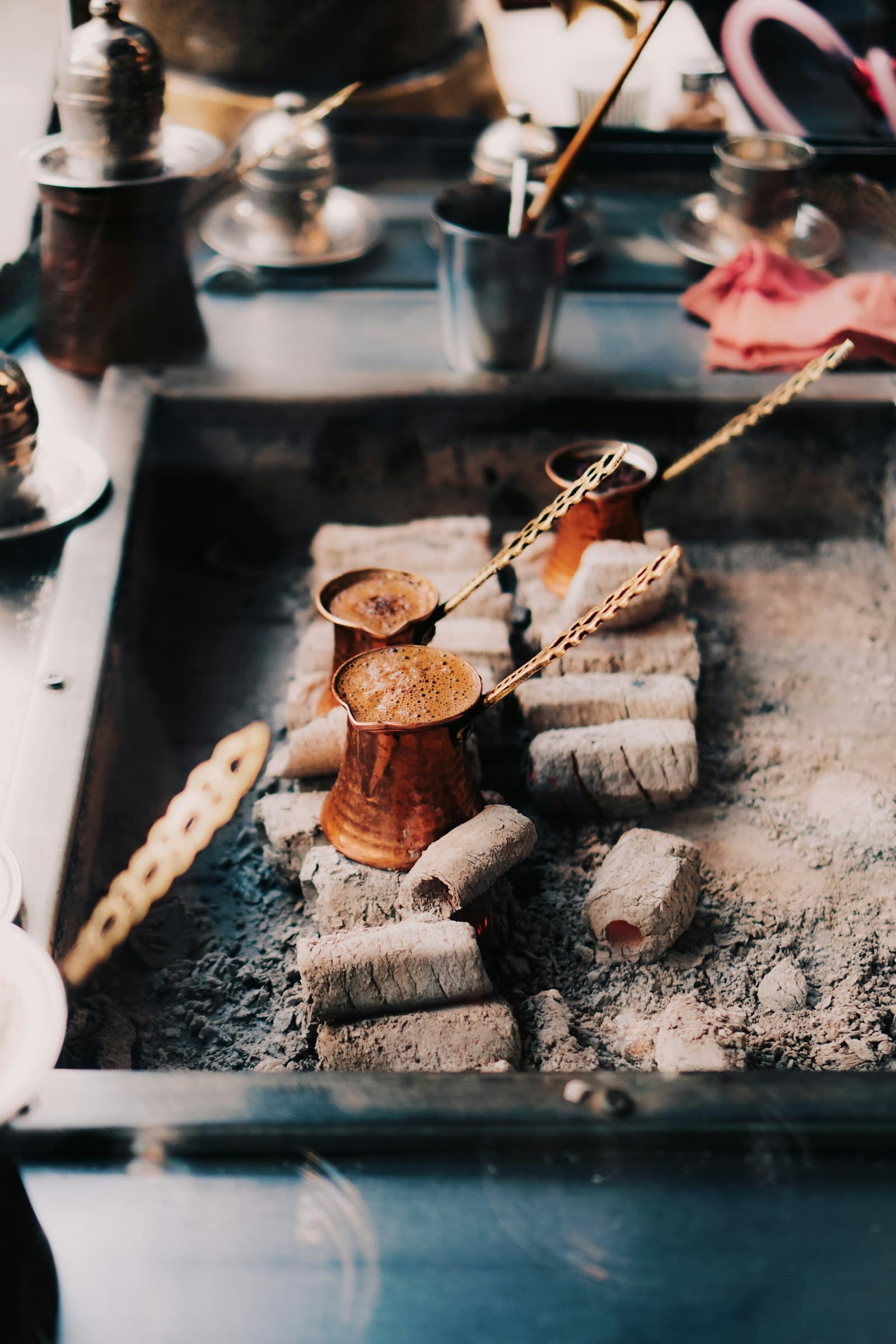
Entering the 16th century, coffee spread rapidly through the Islamic world — to the holy city of Mecca, to Cairo, and to Istanbul, the Ottoman capital. Born in this process were humankind’s first “coffeehouses (kahvehane).” People gathered there, coffee in hand, to talk, recite poetry, argue politics and play chess. So many gathered and debate ran so hot that coffeehouses were even called “schools of the wise (mekteb-i irfan).” Their liveliness at times made the powerful wary; bans were issued more than once on the grounds that they were hotbeds of sedition, but none lasted long against coffee’s appeal. The style of Turkish coffee, boiled together with the grounds, was established in this era.
- A place of society: a “third place,” neither home nor work, where people gathered and talked across ranks
- A crossroads of information: consulting on trade, exchanging news and rumor, sharing poetry and stories
- A plaza of debate: politics, religion and thought were exchanged, at times watched warily by power
- A cradle of culture: a space of leisure and knowledge where music, chess and literature were nurtured
To Europe — from “the devil’s drink” to the ink of the Enlightenment
In the 17th century, coffee crossed to Europe through the merchants of Venice. At first this black, bitter, infidel drink was viewed warily as “the devil’s drink,” but the tale survives that Pope Clement VIII of the time took a sip, liked it, and jokingly approved it, saying “let us baptize it and make it a Christian drink.” Thereafter coffee spread in a flash, and coffeehouses sprang up in London, Paris and Vienna. London’s coffeehouses were called “penny universities” because anyone could touch the latest news and debate for a small admission. The modern age is born here. Lloyd’s of London and the stock exchange both began in a corner of a coffeehouse. It was in the steam of coffee, too, that the thinkers of the Enlightenment gathered and the debates of the French Revolution were exchanged.
Coffeehouses were not mere eateries. People gathered across ranks, information was exchanged, thought was honed — it is no exaggeration to say the “public sphere” of modern society rose out of the steam of coffee. The path of the kissaten, which played the same role in Japan, is portrayed in detail in a cultural history of the kissaten.
Breaking the monopoly — a single seedling to the world
Yemen’s monopoly was eventually broken. At the end of the 17th century, the Dutch succeeded in secretly taking out living coffee seedlings and began cultivation on the colony of Java (Indonesia). This is why “Java” became another name for coffee. More dramatic still is the tale of the French officer Gabriel de Clieu. He carried a single seedling on an Atlantic voyage, guarding it by sharing his own water on a ship short of water, and brought it to the Caribbean island of Martinique. This one plant is said to have become the ancestor of the countless coffee trees spread across Latin America. The line that went to the French island of Bourbon (now Réunion) became the foundation of the Bourbon variety. Thus Arabica spread explosively from a mere handful of seed to the whole world.
Plantations and slavery — coffee’s history of shadow
Behind coffee’s rise to a world commodity lies a heavy shadow. In the 18th and 19th centuries, the European powers built vast coffee plantations in their colonies, but much of the labor was borne by enslaved people brought from Africa. Saint-Domingue in the Caribbean (now Haiti) was for a time a great producing region making over half the world’s coffee, but it stood on brutal slave labor. The Haitian Revolution that began in 1791 was also an uprising in which those enslaved won their freedom. Before long the center of production shifted to Brazil, where slave labor long continued as well. The cup we drink so casually contains this history of people’s suffering too — to tell coffee’s story, we cannot look away from this shadow.
Coffee’s history is a story of fragrant culture and, at the same time, one that cannot be told apart from the dark side of colonial rule and slave labor. This reckoning connects to today’s fair trade and direct trade — efforts to deliver a fair reward to producers. To think of the human work behind a cup is also part of tasting coffee deeply.
Brazil and popularization — coffee becomes “everyday”
In the 19th century, the lead in coffee production passed to Brazil. Blessed with vast land and climate, Brazil grew in no time into the world’s largest producing country and turned coffee from a “special luxury” into “the everyday of common people.” Production surged, prices fell, and coffee spread to tables around the world. In the 20th century, instant coffee — dissolved with just hot water — was invented, and its convenience spread all at once as it was rationed to soldiers in the two World Wars. As the chart below shows, world coffee production has grown explosively over this past century or so. Coffee is no longer the drink of a few but a colossal commodity crop on a planetary scale.
This chart roughly shows how much world coffee production grew through the 20th century (approximate annual production converted to 60 kg jute bags). Production, around 15 million bags around 1900, has come to exceed 170 million bags by the 2020s. More than tenfold in a century or so — this is the very path of population growth and of coffee soaking into the everyday around the world. At the same time, this rapid growth also bred new challenges: price swings, producer hardship, and the climate change discussed below. The figures are only approximate, and the year-to-year variation between good and poor harvests is large.
The three waves — a return to quality
After an era of mass production and mass consumption, from the latter 20th century coffee began a return to “quality.” This flow is often told in “three waves.” The first wave was the era of “convenience and popularization,” represented by instant and canned coffee. The second wave was the era of “espresso and space,” led by Seattle-style cafés, in which the experience of dark-roast lattes and cafés spread worldwide. And the third wave is the era of specialty coffee, obsessed with origin, variety, processing and roasting, tasting coffee like wine, “by its maker and its individuality.” The bean’s history came to be told, farm names went on labels, and brewing came to be explored scientifically. The spread of this wave is the background to why we can now enjoy such diverse coffee.
The fuller flow of the “three waves” and what each era left behind are explored in a history of coffee — the three waves. Japan, too, saw its own kissaten and home-roasting culture flower, different from the West. See a cultural history of the kissaten for its path. The world’s waves and Japan’s culture have reached today influencing each other.
Coffee today — a global commodity and its producers
Today, coffee is one of the world’s most traded agricultural products, a vast industry involving hundreds of millions from production to consumption. Yet at its feet, serious challenges are advancing. One is climate change. Rising temperatures and disordered weather threaten the growing-suitable land called the coffee belt and spread diseases like leaf rust. The other is producers’ livelihoods. Amid the swings of international prices, many of the smallholders who grow the beans go without a fair reward. Fair trade, direct trade and various certifications are attempts to correct this imbalance. A single cup of coffee connects us with millions of farmers in distant origins — and when you think of that fact, coffee takes on a meaning beyond a mere drink.
Frequently asked questions
Where is the birthplace of coffee?
The birthplace of the Arabica species is the highlands of Ethiopia in East Africa. Wild coffee trees still grow there, and diverse heirloom varieties live on. However, the culture of “coffee as a drink,” roasted and brewed, was established across the Red Sea in Yemen. Around the 15th century, the Sufi devotees who began drinking it to ward off drowsiness are taken as the starting point. So it is accurate to separate them: “the plant’s birthplace is Ethiopia; the birthplace of the drinking culture is Yemen.”
Is the legend of “Kaldi” true?
The tale of Kaldi the goatherd is widely known as an anecdote of coffee’s origin, but there is no evidence it is historical fact. It appears in the literature only in the 17th century and is thought to be a legend born in a later age. That said, since Ethiopia being the birthplace of the Arabica species is botanically certain, the broad outline — “coffee was discovered in the highlands of Ethiopia” — can be called correct. A legend, even if not historical fact, tells a part of the truth.
When did coffee reach Japan?
The first contact on record is the Edo period. Through the Dutch at Dejima in Nagasaki — the one place open to the West under national seclusion — coffee was brought in around the 18th century. At first it belonged to a limited few, but it spread with the “civilization and enlightenment” of the Meiji era. In 1888, the “Kahiichakan,” opened in Ueno, Tokyo, is taken as Japan’s first full-fledged kissaten. The subsequent path of Japan’s own kissaten culture is introduced in detail in a cultural history of the kissaten.
Is coffee really “the second most traded commodity after oil”?
The often-heard claim that “coffee is the second most traded commodity after oil” is in fact not accurate. This phrasing has spread for a long time, but by value there are several commodities traded in larger amounts than coffee. Still, it is a fact that coffee is one of the world’s most actively traded agricultural products and a colossal international commodity supporting the lives of hundreds of millions. Set aside the exaggerated figure, and it is best understood that its economic and social weight is the real thing.
Why were coffeehouses historically important?
Because they created a “public place” where people gathered across ranks and information and debate were exchanged. The London coffeehouses of the 17th and 18th centuries were called “penny universities,” where for a small fee one could touch the latest news and intellectual debate. Lloyd’s insurance and the stock exchange were born here, and the debates of Enlightenment thought and the French Revolution were exchanged in the steam of coffee. Coffeehouses were the cradle of the public sphere of modern society.
What are the “three waves”?
It is a way of grasping the path of coffee’s quality and culture in three stages. The first wave is the era of mass popularization, represented by instant and canned coffee. The second wave is the era of espresso and café space spread by Seattle-style cafés. The third wave is the era of specialty coffee, obsessed with origin, variety, processing and roasting, tasting coffee by its individuality. That we can now enjoy such diverse cups is thanks to the spread of this third wave. For details, see a history of coffee — the three waves.
From a single shrub growing wild in the highlands of Ethiopia, to the Sufi nights of prayer, to the Ottoman coffeehouses, to the Enlightenment tables of Europe, to the colonial farms, to the soil of Brazil, and to breakfast tables around the world — coffee has circled the globe together with humankind. Its road holds both the brilliance of knowledge and society and the shadow of slave labor, and challenges of climate change and producers’ livelihoods continue even now. A cup of coffee is a drink into which a thousand years of time and the work of people all over the world are dissolved. Next time you take a cup in hand, imagine, just a little, the grand journey that black liquid has passed through. Coffee grows deeper the more you drink it, the more you know it.
Was this article helpful?
Choose & compare
Related links
More articles