El Salvador Coffee Deep-Dive: The Sanctuary of Bourbon and the Volcanic Land That Created Pacamara
A small country that protected old Bourbon, its recovery from civil war, and the complex flavor of the giant Pacamara bean
Central America’s smallest country, El Salvador, is known in the coffee world as “the sanctuary of Bourbon.” The hardship of civil war ironically preserved its old heirloom Bourbon, and the country went on to create Pacamara — a large-bean variety the world now prizes. Volcanic soils, a sweet and mellow cup, and the way a single crop has carried a nation’s economy and history: here is the deep story of a small country’s coffee.
Contents · 10
- Why El Salvador is special
- Flavor profile — a coffee of sweetness and balance
- Growing regions — coffee belts shaped by volcanoes
- The sanctuary of Bourbon — why old varieties survived
- Pacamara and Pacas — varieties this country created
- Civil war and recovery — a country carried by coffee
- Processing and grading
- Environment and shade-grown coffee
- How to brew it
- FAQ
Among coffee lovers, El Salvador is a connoisseur’s origin. Rather than overwhelming you with a bold character, its charm is a sweet, mellow, well-balanced cup you can drink all day. Yet behind that gentleness lies a dense story: a history of protecting old Bourbon, the celebrated large-bean Pacamara, and a recovery from the deep wounds of civil war. Why does the smallest country in Central America hold such a special place in coffee? We dig in through volcanoes, varieties, history and processing.
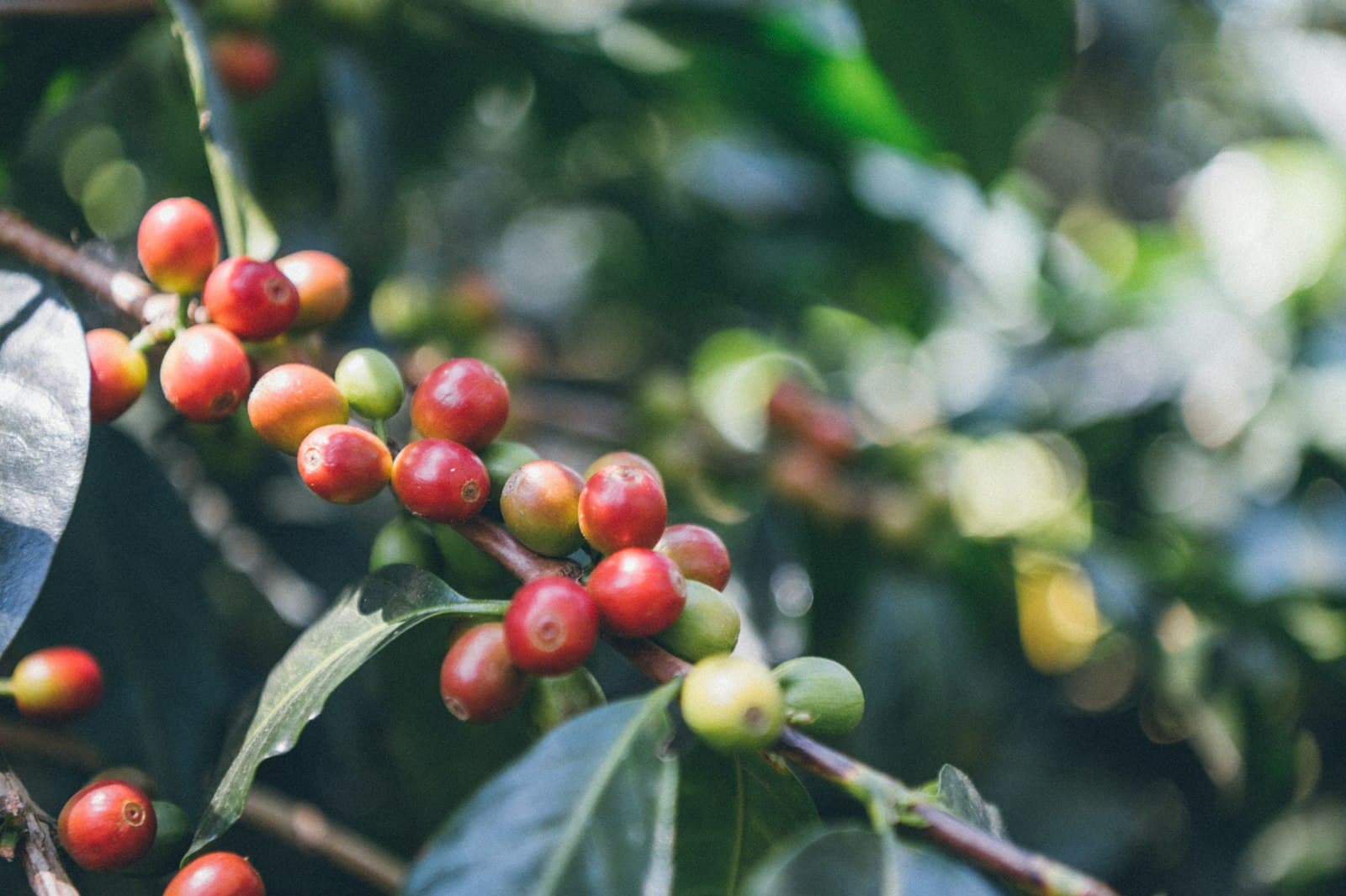
Why El Salvador is special
- A small volcanic country: the smallest in Central America, yet studded with volcanoes whose fertile volcanic soils suit coffee
- The sanctuary of Bourbon: many of its plantings are old heirloom Bourbon. Unlike countries that modernized, the “old-fashioned” flavor survives
- Home of Pacamara: it created Pacamara, a large-bean cross with complex flavor that astonished the competition circuit
- A sweet, mellow cup: chocolate, caramel and soft fruit. Its hallmark is rounded, well-judged balance
- Weight of history: once a “coffee country” where the crop made up most of exports. The memory of war and recovery lives on
El Salvador is a “land of volcanoes,” with volcanic peaks lining an area about half the size of Kyushu. The cool climate of high volcanic slopes and the mineral-rich volcanic-ash soil nurture coffee’s sweetness and complexity. High-grown coffee is graded SHG (Strictly High Grown); fields above 1,200m form the core of the top grades.
Flavor profile — a coffee of sweetness and balance
The El Salvador archetype is not a coffee that overpowers. Milk-chocolate and caramel sweetness, soft acidity, a smooth mouthfeel and overall harmony — “drinkability” and “refined sweetness” are its greatest appeal. It sits at the opposite pole from the showy acidity of African coffees or the heaviness of Indonesia: calm and approachable.
- Sweetness: milk chocolate, caramel, brown sugar. The gentle sweetness Bourbon is known for
- Acidity: mild and rounded. The soft fruit acidity of orange or apple
- Body: medium and creamy. Neither too heavy nor too light
- Pacamara is a class apart: the large bean can show herbal, tropical-fruit and floral complexity
Being “free of off-notes and good with anything” is El Salvador’s strength. It works well as a blend base, and on its own its raw sweetness comes through. It also suits people who first want to find their own taste, or those who dislike sharply acidic coffee.
Growing regions — coffee belts shaped by volcanoes
El Salvador’s coffee grows on the slopes of a volcanic belt running east-west across the country. The government body divides the growing land into six main mountain ranges (cordilleras), each with its own character of altitude and soil. The largest of all is the Apaneca-Ilamatepec range in the west.
- Apaneca-Ilamatepec: the largest region. Around the Santa Ana volcano, Ataco and Juayúa. Many balanced, sweet beans
- Alotepec-Metapán: the northwest. Higher altitude, brighter acidity and cleanliness
- El Bálsamo-Quezaltepec: near the capital. A distinctive flavor shaped by sea breezes
- Tecapa-Chinameca / Cacahuatique: the east. A thick cup with strong chocolate notes
- Chichontepec: the central, lone peak of the San Vicente volcano. Rich, full sweetness
The sanctuary of Bourbon — why old varieties survived
The biggest reason El Salvador is prized in specialty coffee is the abundance of old heirloom Bourbon. While many producing countries replant with newer varieties for yield and disease resistance, old Bourbon remained widespread in El Salvador. Bourbon yields little but is famous for sweet, complex flavor — a “flavor variety.” That genetic resource is now valued as a treasure of the coffee world.
Ironically, one reason Bourbon survived was the civil war and economic stagnation of the 1980s–90s. With little investment in new varieties, old Bourbon was preserved on the farms. A time of hardship ended up safeguarding the “flavor genes” — El Salvador is often called “a living museum of Bourbon.” We cover the variety’s lineage in the story of Bourbon.
Pacamara and Pacas — varieties this country created
El Salvador is also a country that created its own varieties. The flagship is the large-bean Pacamara. In 1958, the national research institute ISIC crossed Pacas — a mutation of Bourbon — with Maragogipe, famous for its giant beans. The name is a contraction of “Pacas + Maragogipe.”
- Pacas: a dwarf (short-stature) mutation of Bourbon found on the Pacas family farm in 1949. Easy to grow, with Bourbon-like flavor
- Maragogipe: a super-large-bean variety from Brazil, also called the “elephant bean”
- Pacamara: a cross of the two above. A big bean with complex, individual flavor like herbs, flowers and tropical fruit
- A competition regular: Pacamara has scored highly again and again at the Cup of Excellence, drawing the world’s attention
Pacamara is a “one-of-a-kind when it hits” variety. A well-grown bean layers lime, passion fruit, herbs and flowers into a complex cup. It costs more, but it is the cup that lets you feel El Salvador’s character most. If you spot one, do try it.
Civil war and recovery — a country carried by coffee
From the late 19th century, coffee was the backbone of El Salvador’s economy; in the 20th century there were times the crop made up most of export earnings. But the civil war from 1980 to 1992 left deep wounds on the industry. Farms fell into neglect and talent and know-how drained away. Then, in 2012–13, the leaf-rust (roya) outbreak that swept Central America piled on more damage. Even so, producers have fought back on quality over quantity — through participation in the Cup of Excellence (from 2003) and a shift to the specialty market. Drawing on the “weapons” of old Bourbon and Pacamara, El Salvador is slowly reclaiming its name on the world map.
Processing and grading
- Processing: traditionally washed. Recently, honey and natural experiments are thriving too
- Grading: by altitude. SHG / SHB (Strictly High Grown, above 1,200m) is the top, followed by HG (High Grown) and CS (Central Standard)
- Smallholders and estates: everything from large estates to small producers. Hand-picking ripe cherries and careful sorting underpin quality
- Drying: sun-drying (on patios or African beds) is standard for quality lots
Environment and shade-grown coffee
Much of El Salvador’s coffee is “shade-grown” under tall trees. In a country where deforestation has advanced, coffee farms are among the few remaining green spaces and a precious habitat for migratory birds and wildlife. A single cup is tied to the conservation of soil, water sources and biodiversity — yet another reason to root for this origin.
How to brew it
El Salvador’s strength is mellow sweetness and balance. To draw that out honestly, clean paper drip is the royal road. To round off the gentle acidity and sweetness, a slightly lower water temperature is easy to handle.
Baseline ratio for the V60 (1:16)
Beans 15g / Water 240g
- Roast: medium is the classic. Sweetness and chocolate notes come through cleanly
- Water temp: 88–92°C. Rounds off the gentle acidity and sweetness
- Brewing: clean paper drip. Taste the raw sweetness honestly
- For Pacamara: a light-to-medium roast to open up its complex aromas
FAQ
What does El Salvador coffee taste like?
Sweet, mellow and well-balanced is the baseline. Milk-chocolate and caramel sweetness, gentle acidity and a smooth mouthfeel make it approachable and free of off-notes. The country’s own Pacamara variety, on the other hand, can show complex, individual flavors like herbs, flowers and tropical fruit — so there is real range within one country.
What is Pacamara?
It is a cross variety El Salvador created, combining the Bourbon mutation “Pacas” with the super-large “Maragogipe.” The beans are very large, and when well grown they develop complex flavors like lime, passion fruit, herbs and flowers. It earned high scores at the Cup of Excellence and became known worldwide.
Why is it called “the sanctuary of Bourbon”?
Because old heirloom Bourbon remained widespread in El Salvador while many producing countries replanted with newer varieties. Civil war and economic stagnation meant little investment in new varieties, which ended up preserving the genetic resource of the “flavor variety” Bourbon. Today that very old Bourbon is the source of the country’s coffee value.
El Salvador’s coffee is an origin you taste for depth rather than flash. Beyond the mellow sweetness of a single cup are volcanic soils, a hard-won old Bourbon, and the history of people who overcame hardship. Next time you spot beans from this small volcanic country, peek at the variety on the label — Bourbon or Pacamara. It may change how the cup tastes to you.
Was this article helpful?
Origins in this article
Choose & compare
Related links
More articles
The Coffee Variety Family Tree — Reading the “Genealogy” That Begins with Typica and Bourbon
BeansThe Coffee Belt and Terroir — Why Coffee Grows Only in the “Equatorial Band,” and Why Each Origin Tastes Different
BeansThe Science of Coffee Acidity — What Fruitiness Really Is, and How It Differs from “Sour”
BeansTaiwan Coffee Deep-Dive: The Tea-Like Cup Born of Alishan’s High Mountains